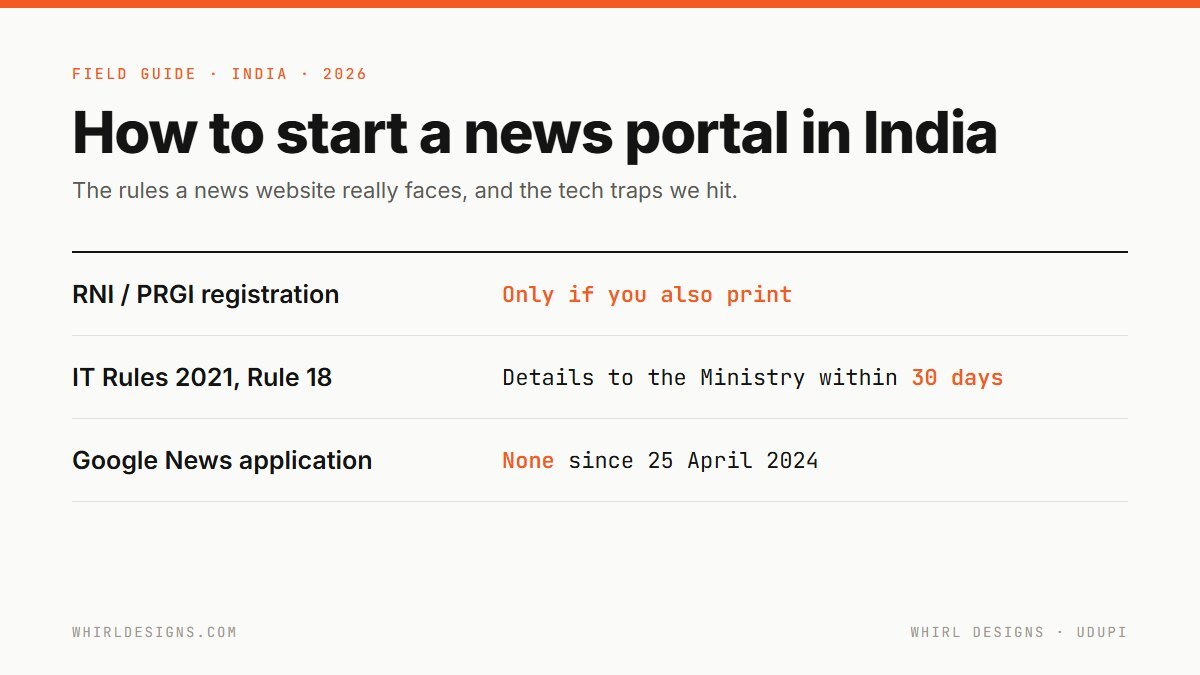
You do not need RNI registration to start a news website. RNI is now PRGI (the Press Registrar General of India), and it registers periodicals that are printed. An online-only news publisher instead sends a short set of details to the Ministry of Information and Broadcasting within 30 days of starting. And there is no Google News application any more: since April 2024, Google finds publishers on its own.
So the paperwork is small. The hard part is the website. It has to stay fast with a homepage full of photos, keep Kannada text correct, show a new story quickly, and look right when shared on WhatsApp.
This guide is for a journalist, stringer or retired editor starting a district or taluk portal, most likely in Kannada. We built Times of Karkala, a daily Kannada and English portal, and moved two Kannada news sites off WordPress in September 2026. The traps below are ones we hit ourselves. We are not lawyers, so check your own case with a media lawyer.
Do you need RNI or PRGI registration for a news website?
Not for a website alone. The Press and Registration of Periodicals Act, 2023 came into force on 1 March 2024. It replaced the 1867 law, and the old RNI office became PRGI (PIB announcement). The Act defines a periodical as a publication "published and printed at regular intervals containing public news or comments on public news" (PRGI advisory). A news site that never prints is not printed, so on that wording it is not a periodical. Vendor pages that still say every portal must register with RNI are out of date.
It changes if you also print. A printed paper registers its title and the periodical online on the government's Press Sewa portal. The title cannot be the same as, or similar to, one already held in the same language anywhere in India, or in any language in the same state. The fee is ₹1,000, paid online. So if you might print one day, check the title before you buy the domain or pay for a logo.
What the IT Rules 2021 ask of a news website
Digital news publishers come under Part III of the IT Rules 2021, run by the Ministry of Information and Broadcasting. In the Ministry's words, there is "no requirement for prior registration". Rule 18 asks you to send information instead, within 30 days of starting. For a publisher that does not also print or broadcast, the format is Appendix II of the Ministry's notice:
- the title, its languages, the website, any apps and every social media account;
- the owner, and the month and year you started publishing news (PAN is optional);
- a contact person and an address in India;
- a grievance officer in India, the self-regulating body you belong to, and your news editors.
A publisher that also prints uses Appendix I instead, which asks for its registration number. Since a corrigendum of 30 May 2025, the form goes as a signed PDF by email to digital-mediamib@gov.in. If a detail changes, you tell the Ministry within 30 days.
The rules also ask you to show the grievance officer's contact details on the site, acknowledge each complaint within 24 hours, decide it within 15 days, and publish a monthly report on complaints. So build a proper About page and Contact page before launch.
There is also a code of ethics, which includes the Press Council's norms of journalistic conduct. On 14 August 2021 the Bombay High Court stayed Rules 9(1) and 9(3), which make that code binding and set up a three-tier system to enforce it (Bar & Bench report). Ask a lawyer where the case stands now, and follow the norms anyway.
Can you apply to Google News?
No. Since 25 April 2024, publishers cannot set up a new publication in Google's Publisher Center. Google says content that follows its policies is "automatically eligible", and its systems rank stories on relevance, prominence, authority, freshness, location and language (Google's notice). There is no form and no fee. Anyone selling "Google News approval" is selling something Google stopped offering.
What you control is what Google's news policies ask for: clear dates and bylines, information about the authors and the publisher, and contact details. Add original local reporting, and submit a sitemap in Google Search Console. If you also make a news sitemap, list only the last two days' stories in it.
WordPress or a custom platform?
For most new portals, WordPress is the right start. Times of Karkala runs on WordPress with a custom theme: district and category sections, Kannada type that stays readable, and an editor workflow for same-day publishing. Many developers know WordPress, so you are never stuck with one person. Its weak spots are plugins and updates; we compared it with hand-built sites in AI-built or WordPress?
A custom platform makes sense later: a bigger newsroom, your own app, or heavy traffic. It brings its own traps. On our two September moves, the pages were built in advance as files. At first, a story published from the admin did not appear at all. Later, section pages stayed frozen until the next full update while the homepage refreshed. Both are fixed now. Ask any builder: "If I publish at 6 a.m., when does it show on the district page?"
Hosting: why news sites fill up
Shared hosting limits the number of files you can keep (the "inode" limit), not just disk space. News sites hit it fast.
This September we cleaned up seven WordPress news sites on one hosting account. They held about 157,000 image files, and the account was at 79% of its 600,000-file limit. Old uploads were not the cause. The news themes registered 16 to 25 image sizes each, so every photo a reporter uploaded became 20 to 30 files. Removing seven unused plugins (10,897 files), 8,890 WebP copies that nothing ever showed, and leftovers from old themes brought it down to 75%. That only buys time.
- Pick a theme with few image sizes, or have your developer switch off the sizes the design never uses.
- Do not trust "unused file" cleaners. Telling a dead file from a live one is harder than it looks, because some plugins build file names only when the page loads. Our own first trial run deleted 1,411 image files that were still in use on one site. We put them back from the backup we had taken first.
Kannada-specific traps
None of these show up when you test in English.
1. Filters that delete vowel signs
Kannada writes most vowels as signs joined to a consonant, and joins letters with the virama (್). Much software does not count those signs as letters. So a "letters and digits only" rule for file names, tags or web addresses quietly strips them. One such filter turned ಶ್ರೀದೇವಿ ಮತ್ತು ಬಳಗ, ಉಡುಪಿ into ಶರದವ_ಮತತ_ಬಳಗ_ಉಡಪ. Test every form and upload with a real Kannada name.
2. Story addresses: pick one rule and never change it
A story's web address can be in Kannada script or in English letters. The trap is changing the rule later. On one of our builds, a better rule for spelling Kannada headlines in English letters changed every address, and a re-import made a second copy of every story. Once an address is published, save it with the story and never rebuild it from the headline.
3. Headline size
Kannada sets taller than English. On one news site we rebuilt, the design's 52-pixel headline swallowed the lead story, so we capped headlines at 34 to 42 pixels. Fonts and Kannada search are covered in Should your website be in Kannada?
Photos, video and speed on a phone
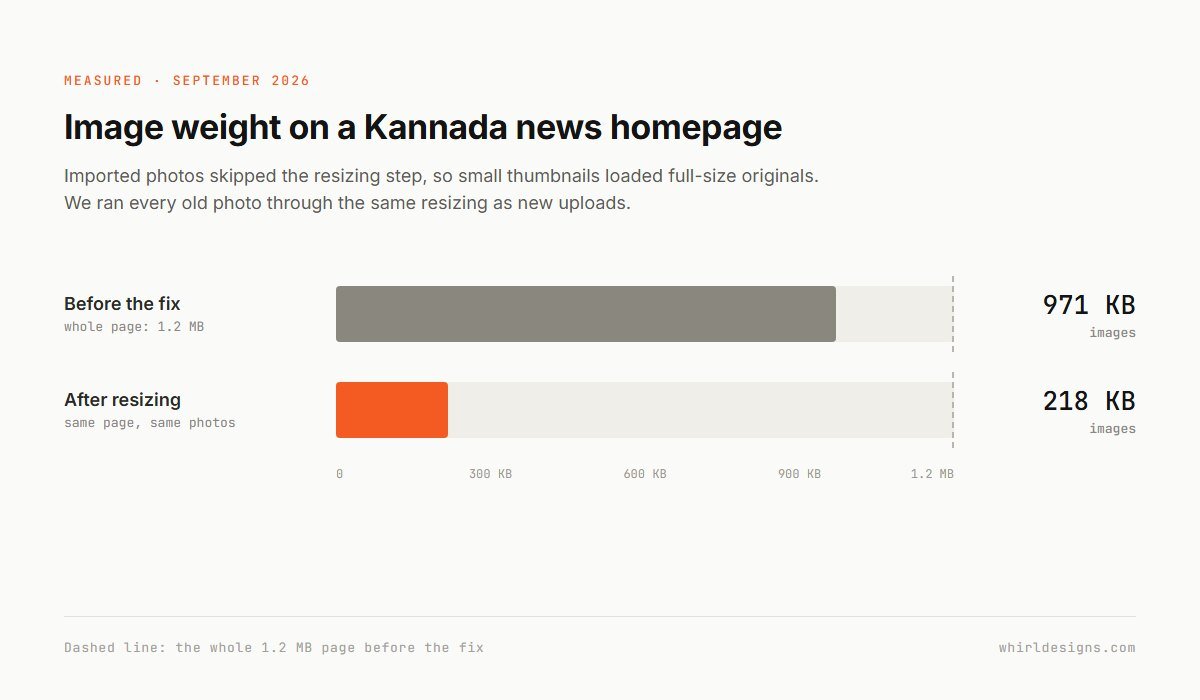
Most of a news homepage is photos. On one site we moved in September, the old photos came across without being resized. A 190-pixel thumbnail loaded a 1,600-pixel original of 424 KB. Images made up 971 KB of a 1.2 MB homepage. Once the old photos went through the same resizing as new uploads, they came to 218 KB.
Video is harder. Shared hosting may not process video at all; ours could not. So the newsroom admin we built shrinks each clip to 720p in the reporter's browser before upload. It takes about as long as the clip, and it does not work in Safari. For long videos, embedding a YouTube upload is simpler.
One warning about speed tests. GTmetrix graded one of these pages C, with the main content taking 2.9 seconds to appear. But it was testing from Seattle over plain HTTP. From India over HTTPS, the same page took 1.0 second. Check where a test runs before you pay anyone to fix it. Our guide to slow websites in India explains the numbers, and our speed service measures before and after.
Make every story share well on WhatsApp
If readers pass your stories around on WhatsApp, the link preview is your front page. WhatsApp shows the picture named in the page's og:image tag, a hidden line that tells apps which image to use. On one Kannada news site we repaired, previews broke for three reasons. The default share image pointed at a deleted file. A second plugin added a second og:image tag. And that image was a WebP file, which WhatsApp did not show.
The fix: one plugin owns the share tags, each story offers its own photo, and a 1200 × 630 JPG card with the logo stands in when a story has none. Then share the plain link into a WhatsApp chat and look.
Moving an existing portal without losing it
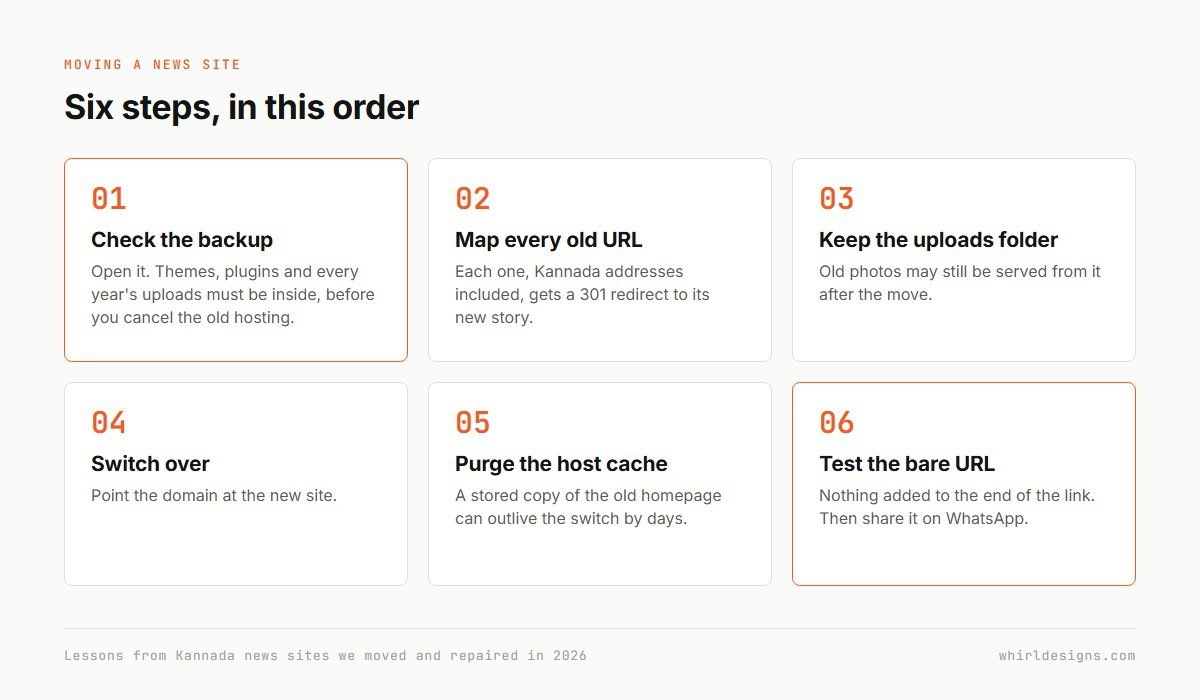
The move is where sites get hurt. This August we repaired two WordPress sites that went blank after a move to new hosting, because the theme folder had not been copied. On one, a Kannada news site, 484 of 504 image files were gone for good. They were not on the server or in the backup zip. Only 2 of its 164 stories kept a usable photo. This is the order we now follow:
- Check the backup. Open it and confirm it holds the themes, the plugins and every year's uploads, before you cancel the old hosting.
- Redirect every old address. On one of our moves, the old addresses were Kannada headlines in the coded form browsers use (%E0%B2…). Each got a permanent (301) redirect to its new story, so old shared links still work.
- Keep the uploads folder. On that site, all 236 photos were still served from the old WordPress uploads folder after the move. Deleting it would have blanked the site.
- Switch over.
- Clear the host's cache. Three days after go-live, the plain homepage address still showed readers and WhatsApp the old WordPress homepage. The host's servers had stored a copy with a seven-day life, set back in the WordPress days. It happened on both sites. Only "Purge all" in the hosting control panel cleared it; otherwise you wait out the seven days.
- Test the plain address. Our checks had added ?x=1 to the link, which skips that stored copy, so all looked fine while readers saw the old site. Test the bare link, and share it on WhatsApp.
This is the work our legacy rescue and migration service is for.
Do you need an app?
Probably not at first. A fast mobile site that shares well on WhatsApp does the job for a new portal. An app earns its place once readers come back daily and you want to send alerts. We set out the test in Do you need an app, or is a website enough?
Your first 30 days
- Choose a name and search the trade marks register on the IP India site. If you may print, check the title on Press Sewa too.
- Buy the domain in your own name, not your developer's.
- Set up sections, bylines, dates, an About page, and a Contact page naming your grievance officer.
- Email the Appendix II details to the Ministry within 30 days of starting.
- Share a test story on WhatsApp, and try every form with Kannada text.
- Add the site to Google Search Console and submit a sitemap.
- Take a backup, then restore it to a test copy to prove it works.
Common questions
Is a YouTube news channel covered by the same rules?
It can be. The IT Rules define a news publisher by what it does, "called by whatever name". They leave out individuals who are not publishing "in the course of systematic business, professional or commercial activity". If your channel is a regular news operation that earns money, assume the rules may apply, and ask a media lawyer. A channel is not printed, so the PRGI registration for periodicals does not apply to it.
Do I need a GST number to run a news portal?
It depends on your turnover and on how you earn: ads, sponsored stories or events. GST registration has a turnover threshold, and the type of income matters too. Ask a CA before you send your first ad invoice.
How long before Google shows my stories?
There is no fixed time. Google finds new sites by crawling them, and its systems decide what appears in Google News. You can help with a sitemap, a date and byline on every story, and original local reporting. Nobody can promise inclusion, and anyone who does is guessing.
If you are starting a Kannada news site, or moving one off a slow WordPress setup, we have done both this year. We can set up the site, the newsroom workflow and the move without losing your old links. See Times of Karkala, read how we approach WordPress development, or tell us about your portal. We are in Udupi and work with publishers across coastal Karnataka.