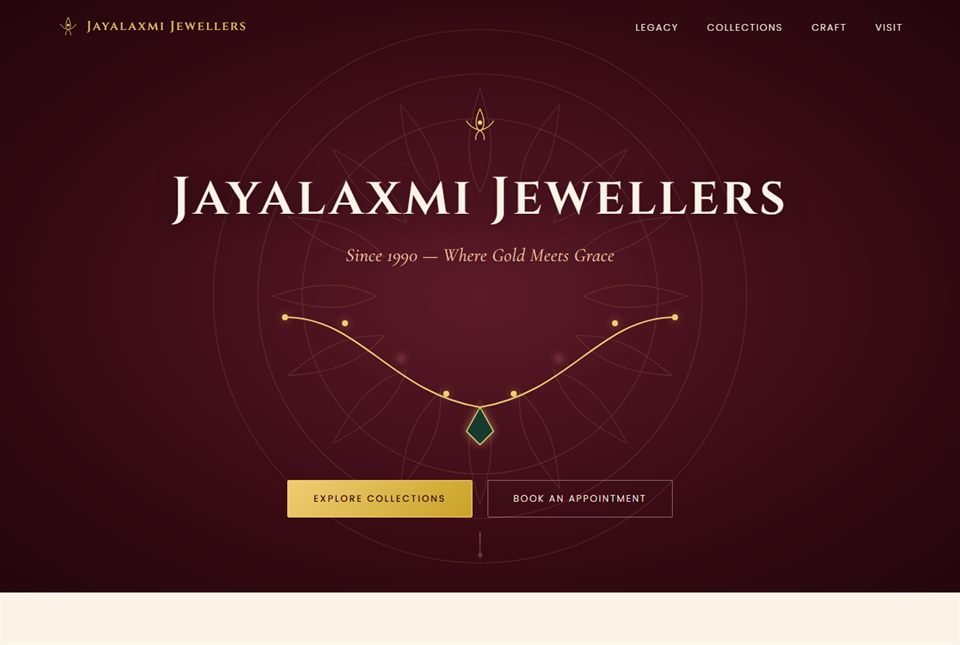
An ordinary website
Best for: One website, edited by one or two people
- The editor and the pages come together, as in WordPress
- Preview, forms and SEO tools work from the first day
- Fewest parts to build, host and hand over

Headless & composable web · Udupi & Mangaluru
We build headless websites for businesses whose content must reach more than one screen: your team edits it once, and the website, app and shop displays all update. Our Udupi studio keeps the editor and each screen up to date after launch.
In short
A headless CMS is a content editor kept apart from the website that displays the content. Your team writes pages, offers and product details once, and a connection called an API delivers them to a website, a mobile app or a screen in a shop. Whirl Designs builds headless setups from its Udupi studio in coastal Karnataka, and says plainly when an ordinary website would do the job.
Start here
Headless is one of four ways to run a website's content. Here is when each one fits, simplest first. The first is right more often than people expect.
Best for: One website, edited by one or two people
Best for: A WordPress team that now needs an app or more screens
Best for: One set of content for a website, an app and shop screens
Best for: Several services joined up: shop, search, payments
We move down this list only when the same content truly has to reach more than one screen. Otherwise we build the first card and tell you why.
Our work
Not one of our clients runs a headless website yet, so this page has no headless case study. The resort shown at the top, with its offer and its three screens, is invented for this page. What we have built is the idea headless rests on: content kept apart from the pages that display it.
Padmavathi Tours & Travels rents out vehicles with a driver in Udupi. We built its 190-page site, which covers every vehicle, route and town its customers search for. Its route and fleet pages are not written one by one. They are generated from a single data file, so each fact is kept in one place and the pages are built from it. A headless build takes that idea one step further: the data file becomes an editor your staff can use, and a connection hands the same content to more than one screen.
Closest projects
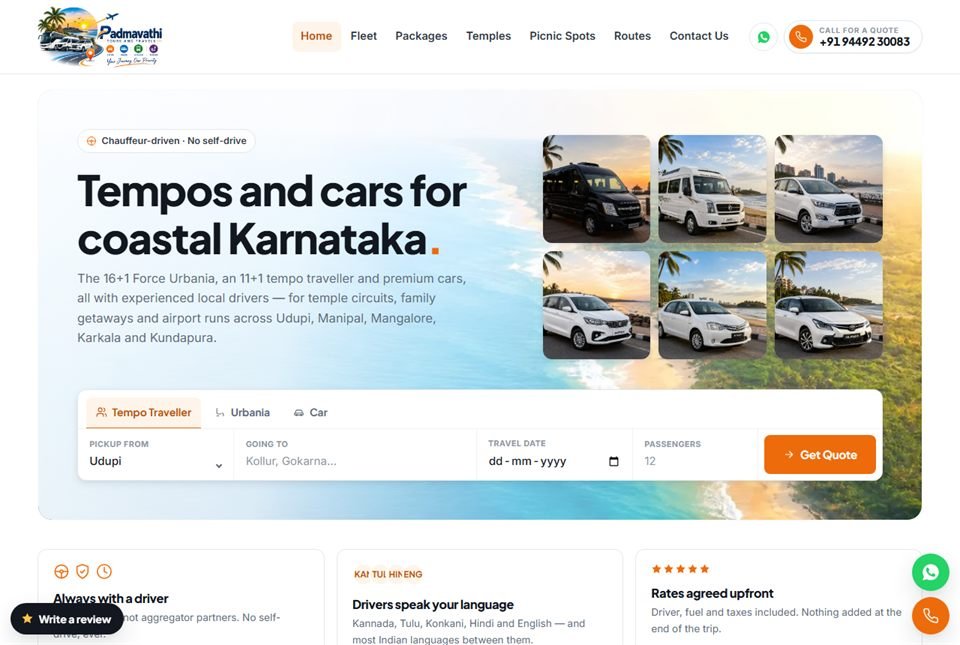 Padmavathi Tours & Travels
Travel & transport · Udupi
A chauffeur-hire company with almost no online presence, rebuilt as a 190-page site that answers the exact searches its customers type — every vehicle, every route, every town.
Padmavathi Tours & Travels
Travel & transport · Udupi
A chauffeur-hire company with almost no online presence, rebuilt as a 190-page site that answers the exact searches its customers type — every vehicle, every route, every town.
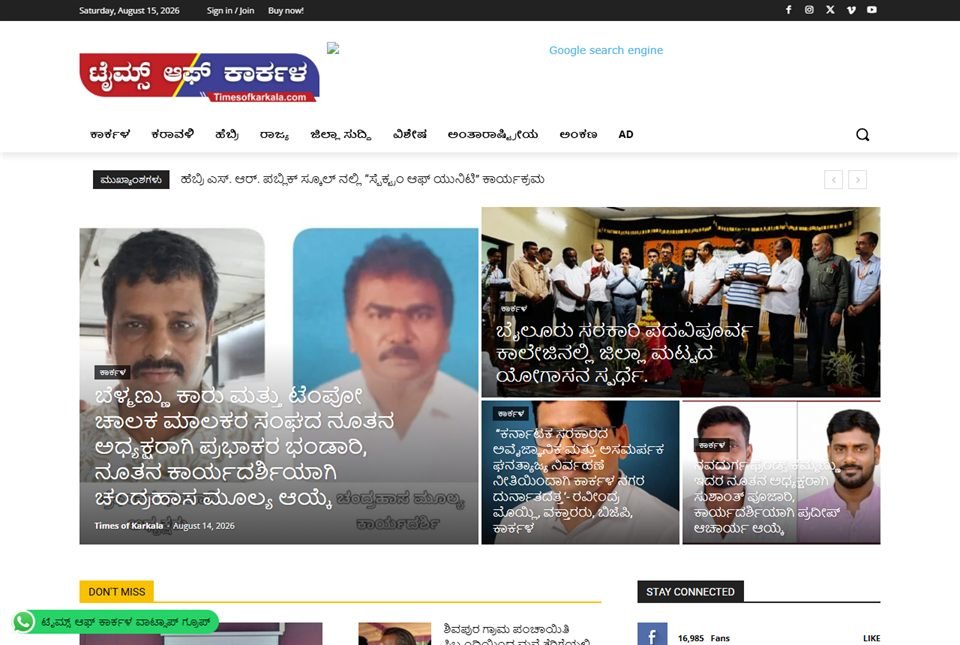 Times of Karkala
News & media · Karkala
A regional news portal publishing daily in Kannada and English, built to stay quick under a homepage full of images and a newsroom posting all day.
Times of Karkala
News & media · Karkala
A regional news portal publishing daily in Kannada and English, built to stay quick under a homepage full of images and a newsroom posting all day.
What you get
Headless projects tend to go wrong in the same places: editors who cannot preview, pages that search engines cannot read, and services nobody remembers setting up. Each of these is planned with you and written down before we start.
How it runs
Your editors work with real content on a real page early in the project, not only at the end.
We list every screen the content has to reach and every person who edits it. If the answer is one website and one editor, we say so here and suggest an ordinary build.
The content model, roles, languages, the CMS we suggest (Strapi, Sanity, Contentful or WordPress) and the reason for it, and where each part will be hosted. You approve it before building starts.
A single page type is built all the way through: editor, preview, live page and publishing. Your editors try it on their own content while it is still easy to change.
Existing pages are moved into the CMS, and every old web address is redirected to its new one, so links that people and Google already have keep working.
Your team learns the editor on its own pages. Before launch we publish test changes and check that each one appears on every screen it should.
The CMS, the code libraries and the hosting all need updates. Those updates, new page types and fixes come from the people who built the setup, so nobody has to learn it from scratch.
Not a fit
Questions
Yes, as long as each page reaches search engines already filled in. The risk is a site that assembles each page inside the visitor's browser: Google may add it to search late, and many AI tools that read websites do not run the code that fills such pages, so they see an empty shell. Every page we build arrives complete, and before launch we fetch pages the way a search engine does to check that nothing is missing.
Strapi suits a business that wants its content on its own server, WordPress suits a team that already knows it, and Sanity or Contentful suit a team that would rather not look after a CMS server at all. With the hosted ones, your content sits on their platform under their terms. The written plan names one option and explains why it fits the people who edit and the screens the content must reach.
Yes. WordPress can pass its content to a website built separately, and your editors keep the screens they know. The catch is plugins: anything that changes what visitors see, such as forms, sliders or SEO output, stops working on the new site. We list those plugins first and plan how each one is replaced.
Headless separates the content editor from the website that shows it. Composable goes further: the whole site is put together from separate services, such as content, shop, search and payments, joined by APIs, and any one of them can be swapped. You may also see the word MACH, which is a name for the same idea. Most small businesses need headless at most; composable fits when several such services are already in use.
Usually only once a store has outgrown what a Shopify theme can do. Shopify keeps the checkout, stock and orders, and headless replaces only the shop front with a separately built site. It fits when the store needs pages a theme cannot make, or when the same catalogue has to appear in an app too. Otherwise a well-tuned Shopify theme is simpler, and your Shopify apps keep working.
A small headless site with a few content types usually takes eight to twelve weeks. A setup that also feeds an app or shop screens, or that moves a large old site, usually runs to four or five months. Moving content and training editors often take as long as the build itself, so both are in the plan from the start.
Yes. Each piece of content can hold a Kannada and an English version side by side in the editor, and each screen asks for the language it needs. Each language also gets its own web address, so Google can show Kannada searchers the Kannada page. For teams in Udupi, Manipal, Mangaluru, Karkala or Kundapura, we can train your editors in person.
It removes one common risk: the admin login is not part of the public website, and many pages are served as ready-made files. But the CMS, the keys that let the services talk to each other, and each connected service still need updates and strong logins. So the security work moves to new places rather than going away, and it is part of the support we give after launch.
Worth reading first
Clean, documented, tested code on a modern, proven stack — the foundation that keeps your headless & composable web fast and dependable for years.
Ready when you are
Tell us which screens your content must reach and who edits it, and you will get a written plan in plain words that also says whether headless suits you at all.