Tally, perhaps with an add-on
Best for: Books, GST filing and simple stock
- Your accountant already knows it
- Billing and stock can sit in the same place
- Gets hard to manage once job work, several sites or many counters come in

ERP development · Udupi & Mangaluru
We build ERPs for work that ready-made software handles badly: job work in manufacturing, jewellery and diamonds, construction sites. Each one goes live a module at a time, and the people in Udupi who built it keep looking after it.
In short
ERP (enterprise resource planning) software is one system that runs a business's daily work, from buying and stock to production, sales, billing and GST, so every department works from the same live figures instead of separate registers. Whirl Designs builds custom ERPs in Udupi, coastal Karnataka, around each trade's own rules, such as job work, wastage or site stock, and switches them on one module at a time.
Start here
Plenty of businesses that ask for an ERP need less than they think. These are the three real options, simplest first.
Best for: Books, GST filing and simple stock
Best for: Trading or manufacturing done the standard way
Best for: Trade rules that ready-made products get wrong
Not sure which one fits? Bring your registers, challans and a week of bills to the first meeting, and we will tell you plainly.
Our work
Facet — Diamond & Jewellery ERP
Manufacturing ERP · Private system
Facet is a manufacturing ERP for the diamond and jewellery trade. In that trade one lot passes through many hands on its way from rough stone to finished piece, and karigars take material out for work and bring pieces back. A little is lost at each step, so the owner needs to know where every lot is and how much went as wastage.
Facet is built on ERP Sutra, our own product arm. One shared layer handles logins, roles, the record of who changed what, and backups, and industry ERPs sit on top of it, live with paying users on ordinary shared hosting. Only Facet's own users can sign in to it, so this page explains its work in words and shows none of its screens.
Also built by us
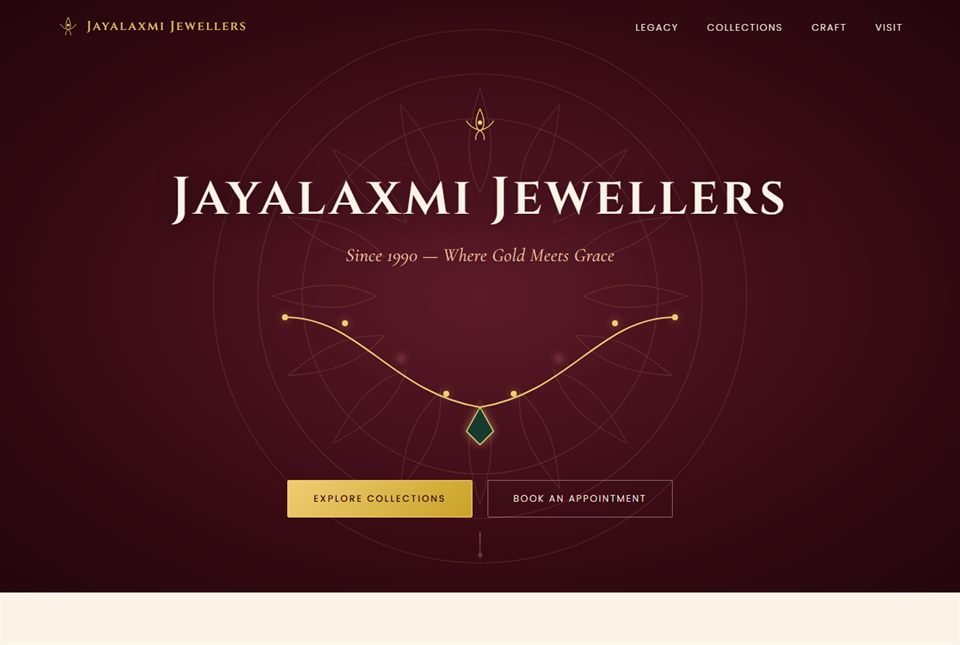 Jayalaxmi Jewellers
Retail jewellery · Karkala
A brand site for a gold house trading since 1990, built to feel like the shop it represents — and backed by a full retail ERP handling billing, savings schemes and old-gold exchange.
Jayalaxmi Jewellers
Retail jewellery · Karkala
A brand site for a gold house trading since 1990, built to feel like the shop it represents — and backed by a full retail ERP handling billing, savings schemes and old-gold exchange.
What you get
One part is different for every trade. The other five come with every ERP, and all six are written into the plan before work begins.
How it runs
Your business keeps running on its old method until each new module has proved itself.
From purchase to dispatch, we follow the work with the people who do it, at your factory, shop or site, and collect the registers, challans and spreadsheets in use today.
The plan names each module, who uses it, the rules it follows and the reports it gives. It also picks the first module, usually the one where mistakes hurt most today. Nothing is built until you sign it off.
Items, parties and opening balances move in from your old registers and spreadsheets, and the totals are checked with you before anyone bills from the new system.
The first module runs next to the old method for a few weeks. We train staff at your premises on their real daily entries, and the old register is dropped only when the two agree.
The next module starts only after the last one has settled. When GST rules change or you need a new report, the people who wrote the system make the change.
Not a fit
Hearing this early saves you months.
Questions
The first module is usually in daily use within six to ten weeks. A fuller ERP covering stock, purchase, job work, GST and reports usually takes four to eight months, because each module settles before the next one starts. What changes the pace most is how quickly your team checks each part, and how clean your current stock records are.
Most ERPs have purchase, stock, sales and billing, production or job work, GST and reports, with a link to your accounts. Payroll is added when a business needs it. Rebar, our ERP for reinforcement-steel contractors, handles weekly labour runs and produces PF ECR (the monthly PF upload), ESI and Form 24Q (TDS on salaries) output, with income-tax slabs kept as data rather than written into the program. We build only the modules you will use.
Yes, and for most businesses Tally should stay. Your accountant keeps the books and files GST in it, while the ERP runs the counter, the floor and the sites. Entries reach Tally either as a file it imports or through a direct link, so nobody types a bill twice. Before we build that link, we agree with your accountant how each entry should post.
Yes. If your business must issue e-invoices, the ERP sends each bill to the government's e-invoice portal through an approved GST provider and prints the invoice reference number (IRN) and signed QR code that come back. Facet, our jewellery ERP, does this through ClearTax. The e-way bill can be raised from the same invoice when goods travel, and GSTR-1 and GSTR-3B totals are drawn from the same entries, ready for your accountant to check and file.
Yes. Each lot sent to a job worker or karigar goes out on a challan with its weight or count, and what comes back is booked against that challan, with the wastage allowed and the actual loss side by side. The system warns you before a challan nears the GST one-year limit for returning inputs, and keeps the details your ITC-04 job work return asks for.
Yes. Staff open it in the phone's browser or pin it to the home screen, and the same screens work on office computers. At Nityanand Agro, an agri-products business, staff bill from their phones, print receipts to a Bluetooth thermal printer and keep working over patchy rural signal. On a factory floor or a building site, that means entries are made where the work happens.
You do. We hand over the full source code and database, and the hosting account is opened under your business's name. Your data can be exported at any time. Our own ERPs run on ordinary shared hosting, and yours can too unless the plan shows it needs its own server. Written notes on how the system works come with it, so another developer could take over.
Yes. An ERP has to fit the work as it really happens, so we travel from our Udupi studio to your factory, shop or site in Udupi, Manipal, Mangaluru, Karkala or Kundapura. You are also welcome to visit the studio. Staff screens and printed challans can show Kannada alongside English. Businesses elsewhere in India work with us remotely, from the same written plan.
Worth reading first
Clean, documented, tested code on a modern, proven stack — the foundation that keeps your erp development fast and dependable for years.
Ready when you are
Show us how stock, job work and billing move through your business today, and we will send back a written plan for the first module.