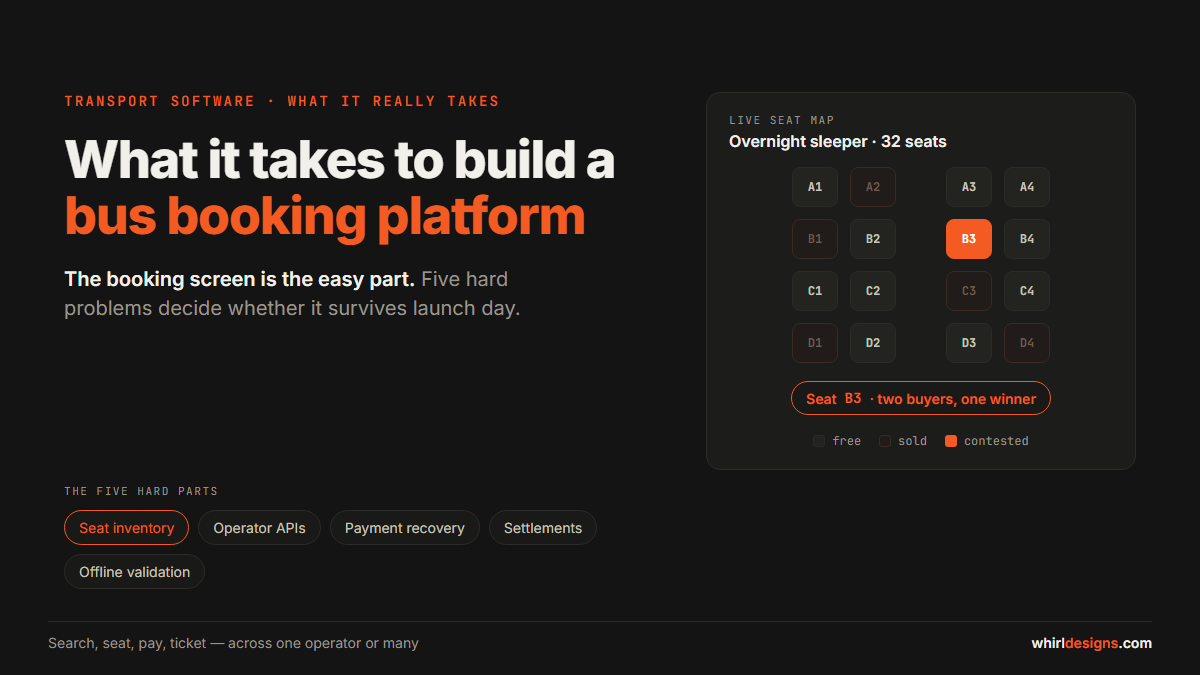
A bus booking platform lets passengers search trips, pick a seat, pay and get a ticket, while pulling live seat availability from one or many operators. The booking screen is the easy part. Five hard problems decide whether it survives launch day: seat inventory, operator integration, payment-to-ticket recovery, settlements, and offline validation.
We build these. A convincing demo takes about a month. The other nine to thirteen months go on what happens when two passengers, two networks and two operator systems disagree in the same instant — which, on a long-weekend morning, they will.
Two people, one seat
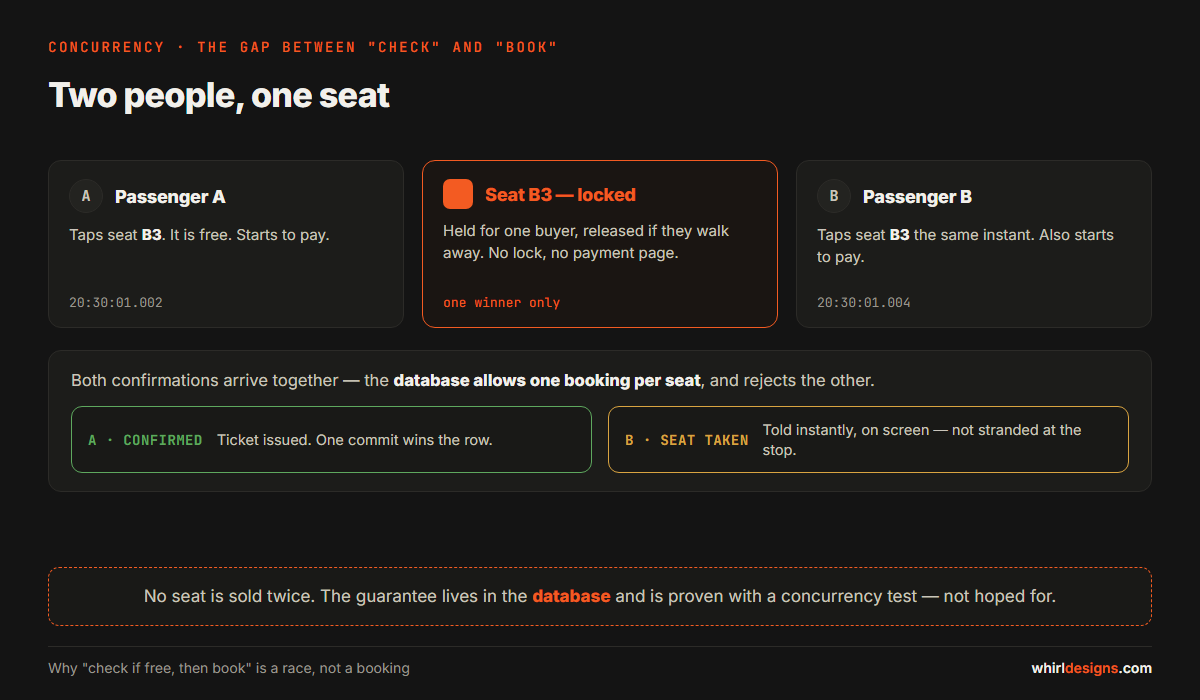
This one looks trivial and is not. A seat is free. Two people want it. Your code checks that it is free, then books it. Between the check and the book there is a gap, and in that gap lives every double-booking you will ever ship.
Most days it is microseconds wide and nobody falls in. On the morning seats open for a festival weekend, a hundred people hit the same window seat in the same second, and it becomes a certainty. "Check if free, then book" is not a booking system. It is a race.
You need two things instead. First, a seat lock with an expiry: when a passenger opens a seat you hold it, long enough to pay, and release it automatically if they leave. No lock, no payment page. Second — the part people skip — a database-level guarantee that exactly one booking can win a contested seat. Not application code that is "careful," but a constraint the database itself enforces, so that when two confirmations land together, one commits and the other is rejected — every time, no clever timing on your side.
You cannot test carefulness; you can test a guarantee. Before we call seat booking done, we run a concurrency test — many simulated passengers racing for one seat, repeated — and count the winners. The only acceptable number is one. A double-booking is not a bug report. It is a passenger at a roadside stop at 11pm holding a valid ticket for a seat that already has someone in it, and nothing loses a customer for good faster.
Every operator speaks a different language
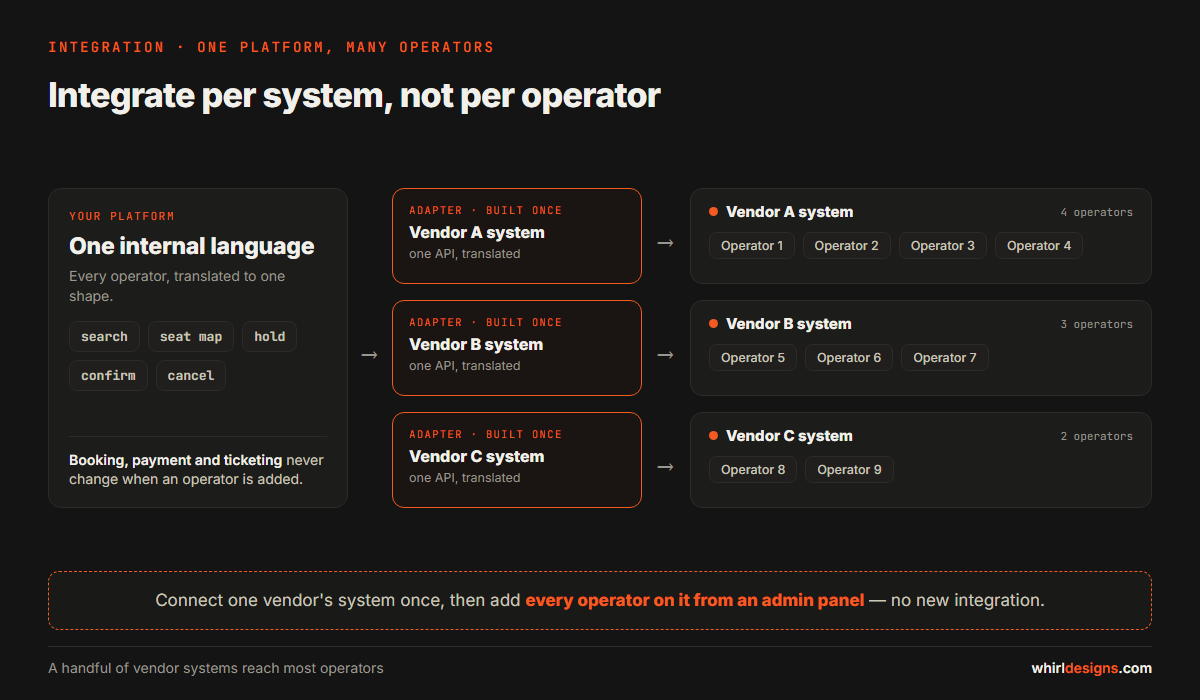
A single-operator platform is a straight line. A multi-operator one is a translation problem: every operator's system exposes a different API, with different fields, rules, and ideas of what a "seat" even is.
Wire those differences straight into your checkout and you have built a trap — operator five arrives and you are editing the payment code. The fix is an adapter layer: a thin translator between your platform and each operator's API. Your booking, payment and ticketing code speaks one internal language; each adapter speaks that language on one side and the operator's on the other. Adding an operator never touches the parts that already work.
Here is the insight that changes the economics, and most people get it wrong: integration is per software system, not per operator. Most operators don't build their own software — they buy it from a handful of vendors whose booking systems are shared across much of the industry. Connect one vendor's system and every other operator running it is no longer an integration at all — they are added from an admin panel with a key and a few settings. Plan the build around systems and it is finite. Plan it around operators and it never ends.
Before any operator goes live, check what their API truly supports — not the sales deck, the endpoints: search, seat map, hold, confirm, cancel. The one that catches people is hold. Some systems can confirm a booking but cannot hold a seat while your passenger types their card details, and a seat that can vanish mid-payment cannot be sold live. For those, sell from a fixed block allocated to you in advance, which you control. The rule we never break: never sell a seat the operator's system cannot guarantee.
The payment that succeeds but the ticket that doesn't
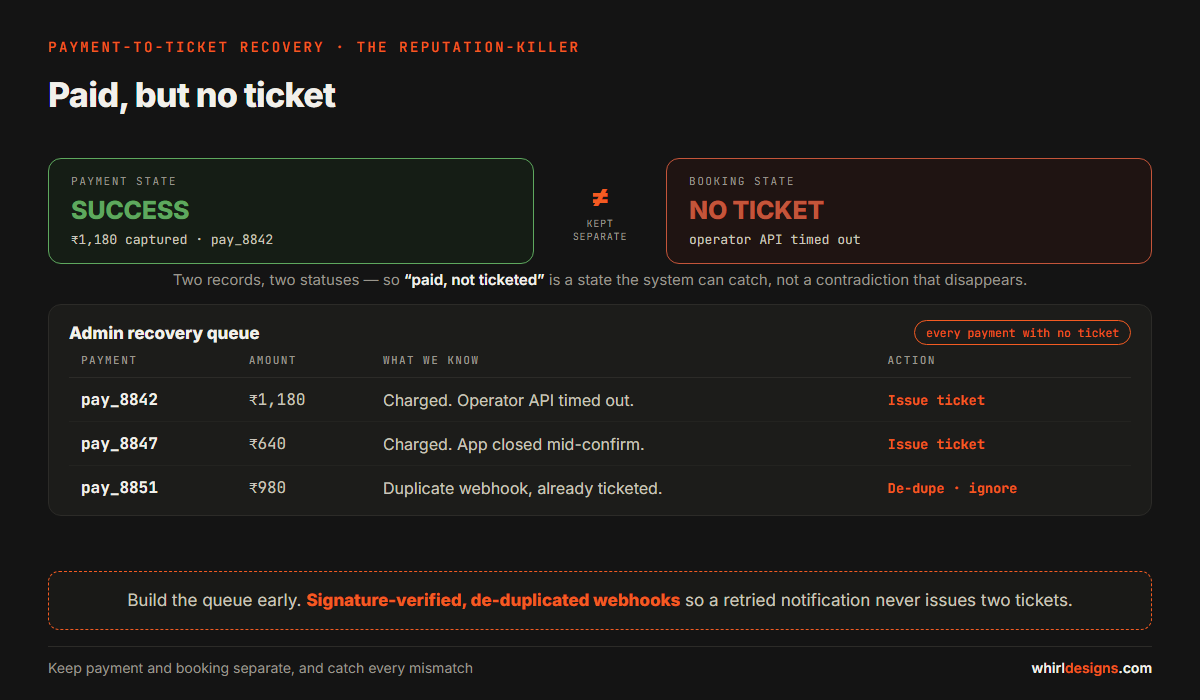
Ask any booking business for its worst support day: this is it. The passenger's money left their account. No ticket arrived. As far as they are concerned, you took their money and gave nothing.
It happens because payment and ticketing are two systems that must both succeed, and sometimes only the first does: the card is charged, then the operator's API times out, or the network drops at the wrong second. You cannot prevent this entirely, but you can decide, before launch, that every such case is caught, visible and recoverable. That takes three things.
- Keep payment state separate from booking state. Two records that reference each other, each with its own status, so that
paid, not ticketedis a state the system can represent — not a contradiction that falls through the cracks. - Build a recovery workflow. An admin queue of every payment with no matching ticket — who paid, how much, for which trip, what is known, and the action to take: issue, or refund. Build it early and deliberately.
- Verify and de-duplicate webhooks. Gateways announce a payment by calling your server, and they will call more than once for the same one. Verify the signature on every notification so you trust it, and de-duplicate so a retried notification never issues a second ticket.
Commission and settlement that survive an audit
Eventually someone asks you to prove a number — an operator says they are owed more than you paid. You answer instantly, with evidence, every time.
- Freeze the commission rate onto each booking at the moment it is made. Raise your rate next month and last month's bookings still read the old one — stored on the booking, never a live lookup that rewrites history.
- Use an append-only ledger. Money records are written once and never edited in place. A mistake is corrected the way accountants do it: post a reversing entry and a fresh correct one, leaving both visible. An edited ledger is not evidence; an append-only one is.
- Produce an operator statement on demand. For any operator and any period, every figure drills down to the transactions behind it. No spreadsheet, no overnight job.
- Keep the money out of the platform. Passengers pay into the owner's own payment gateway, in the owner's name. The platform calculates what each operator is owed; the owner authorises the payout. You are the system of record for the money, not the holder of it — both a compliance reality and a protection.
The conductor has no signal
The whole chain ends at a bus on a highway, and so does your connectivity. Validation — checking that the person boarding holds a real ticket for this trip — happens where the signal does not.
So the conductor's tool must work offline. Not degrade gracefully — work. Before the trip it downloads the manifest for that bus to the phone; at the stop the conductor scans tickets and marks people boarded with no network at all, and syncs when signal returns. One case must be designed for because it is how people cheat: the same ticket scanned on two phones. Online you catch it instantly; offline, each phone only knows what it has seen. So a ticket marked boarded on two devices must not pass silently on both — it goes to a conflict review when the devices sync.
How long does a bus booking platform take to build?
A full multi-operator platform — passenger site, operator APIs, payments, settlements, a conductor app and passenger mobile apps — is realistically ten to fourteen months with a team of four. Anyone quoting six weeks is quoting the demo.
The biggest variable by far is the operator APIs, and it is mostly out of your hands. A vendor with a clean, documented, sandboxed API is roughly a two-week integration — read the docs, test against the sandbox, go live. A vendor with no sandbox, thin documentation and slow replies is six to eight weeks for the same single operator, most of it spent waiting on email, not coding. Each additional operator adapter after the first is roughly two to four weeks.
Should you buy a ready-made script instead?
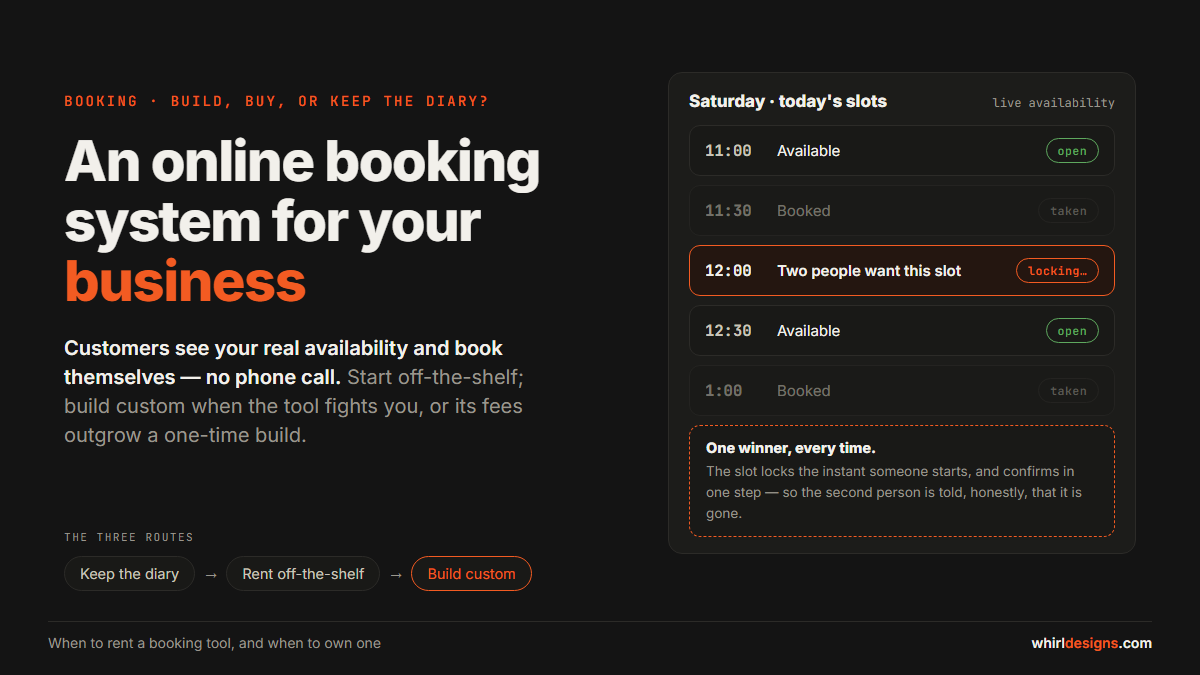
You will find bus booking scripts for sale that promise the whole thing for the price of a weekend. They are real, and they do a real part of the job: the seat map renders, the payment button works, the demo impresses in ten minutes.
What they almost never handle is exactly the five problems above — the concurrency guarantee, the payment-to-ticket recovery, the audit-ready settlements, the offline conductor. Those are the parts that do not show up in a demo and do decide whether you make it past launch day. For a single operator at modest volume, a good script can be a reasonable start. For a multi-operator platform meant to take festival-weekend load, it is a fast demo and a slow trap.
Common questions
What is a multi-operator bus booking platform?
One system that sells seats for many bus operators at once. The passenger searches across operators, picks any trip and pays once; behind the scenes the platform talks to each operator's own system, holds, confirms and issues the ticket — so the passenger sees one shop, not twenty.
Is a ready-made bus booking script cheaper?
Cheaper to start, yes. The script handles the seat map and the payment button. It rarely handles concurrency, payment recovery or settlement — the logic that decides whether the platform holds up under real load — so you usually pay the difference later, rebuilding the hard parts on a base you do not own.
Do passenger payments go to the platform or the operators?
Into the owner's own payment gateway — not the platform's, and not straight to each operator. The platform then calculates what every operator is owed and the owner authorises the payouts. The platform is the system of record for the money; it does not hold the money, which is cleaner for compliance.
How long does it take to build one?
Realistically ten to fourteen months with a team of four. The biggest variable is the operator APIs: a clean, sandboxed vendor is about two weeks to integrate; one with no sandbox can be six to eight weeks.
We build this as a web application development project when it has to carry real traffic, and as custom software development when the booking, settlement and conductor logic has to fit the way you actually run. The operator connections are API integration work, and the money side is payment gateway work. If you are selling for one business rather than many, start with an online booking system for a single business; if the hard part is joining other people's systems, see how we approach software integrations. When you are ready, contact us with the operators you want to connect, and we will tell you which are a two-week job and which are a two-month one.