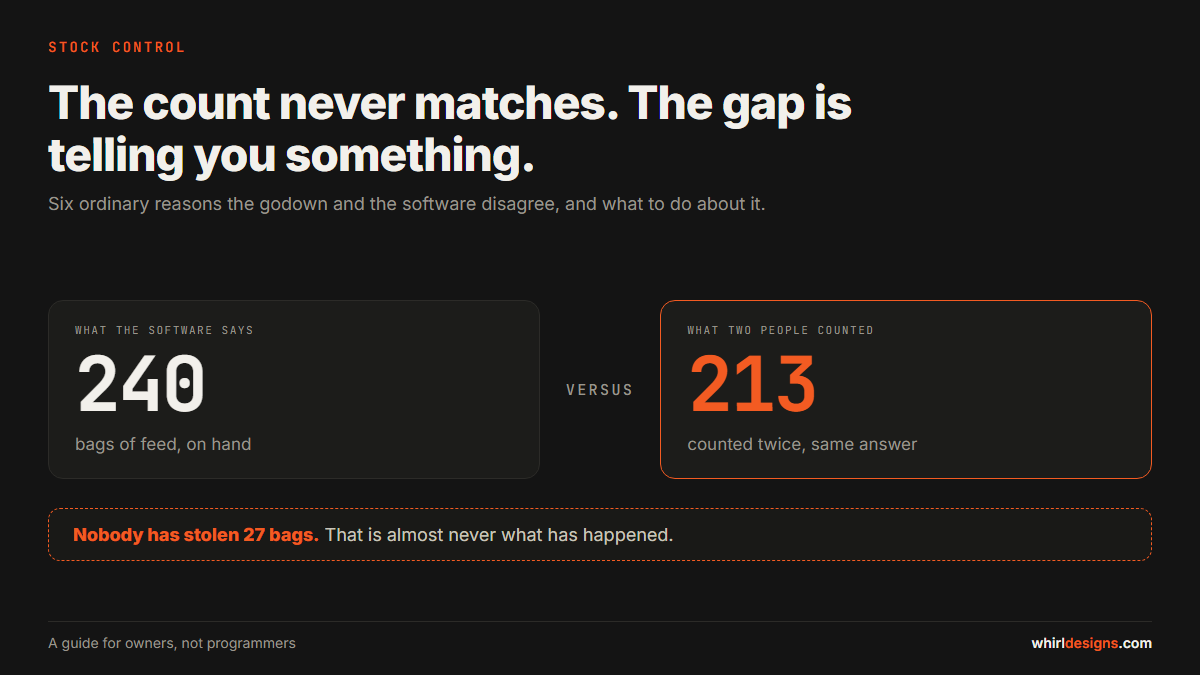
It is the first week of April in a godown off the Karkala road. Two boys are counting bags of cattle feed by torchlight, because the tube light at the back went last month and nobody replaced it. The owner is standing at the door with a printout from his billing software. The printout says 240 bags. The boys have counted 213. They count again. Still 213.
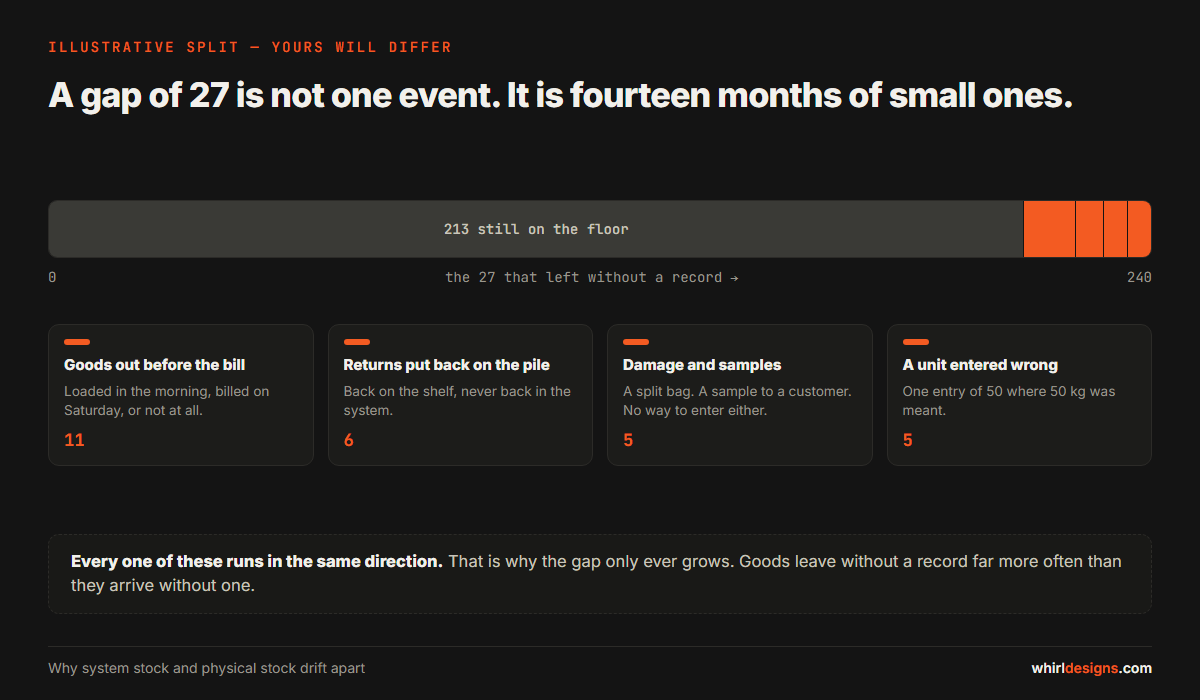
Nobody has stolen 27 bags. That is almost never what has happened. But the number in the system and the number on the floor have been drifting apart for about fourteen months, and today is simply the day somebody looked.
This article is about that gap. What really causes it, how to run a count that tells you something useful instead of starting an argument, and what to do with the difference once you have it. It is written for the owner, not for a programmer. You do not need to know anything about databases to follow it.
The gap is information, not a verdict
The first thing most owners do with a difference is treat it as an accusation. Somebody is careless, or somebody is stealing. That reaction is understandable and it is usually wrong, and it does real damage, because the staff who could explain the difference go quiet the moment the conversation turns into a search for blame.
A difference between system stock and physical stock is a measurement. It tells you that something your business does regularly is not being recorded. Your job is to find out which thing, not who.
Here is the test. If the shortfall is spread thinly across many items, you have a process problem. If it sits on two or three valuable items and nothing else, that is worth a closer look. Most of the counts we have sat through in Udupi and Mangaluru are the first kind.
The six things that actually cause it
1. Goods went out before the bill was made
This is the biggest single cause and it is rarely anybody's fault. A regular customer rings at eight in the morning, the goods go on the tempo, and the bill gets made in the afternoon, or the next morning, or on Saturday when the accountant comes. Sometimes it gets made and sometimes it does not.
Every hour between the goods leaving and the entry being made is an hour where the system is wrong. Most of those entries do get made. The problem is the few that do not.
It is worth doing the arithmetic on your own business, because the scale surprises people. Suppose you send out five deliveries on a busy day ahead of the paperwork. Suppose that on nine days out of ten, every one of them gets billed correctly, which is a better record than most godowns manage. That still leaves one unbilled delivery every two weeks. Over fourteen months that is roughly thirty deliveries that left and never left the system.
Nothing in that story involves carelessness, and nothing in it involves theft. It is an ordinary business running at ninety-eight per cent accuracy. Ninety-eight per cent is not good enough when the errors only ever run in one direction, and this particular error always does, because goods that leave without a bill are never corrected by goods that arrive without one.
2. Returns that came back to the shelf but not to the system
A customer returns four bags because the order was wrong. The staff put them straight back on the pile, which is the sensible thing to do. The credit note either never gets raised, or it gets raised against the bill without the stock going back in.
Note that this error runs the other way. It makes the physical count higher than the system. If your count comes out above the system figure, unrecorded returns are usually the first place to look.
3. Units, and the quiet damage they do
You buy in quintals, you store in bags, you sell loose by the kilo. Somewhere in that chain the software has one unit and the person entering has another. One entry of 50 where 50 kg was meant and 50 bags was recorded will wreck a year of figures on its own.
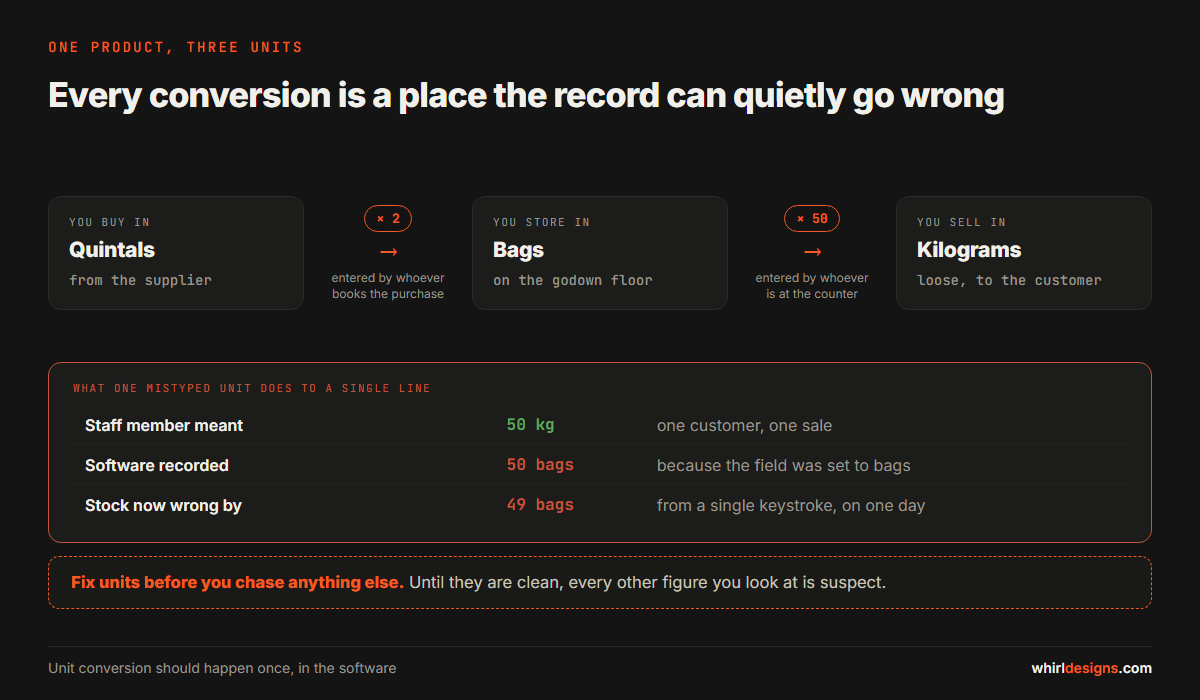
This one is worth checking first because it is the cheapest to fix and it hides the others. Until your units are clean, every other number you look at is suspect.
4. Transfers counted once instead of twice
If you have a second godown, or a shop and a store, stock moves between them. A move is two entries. It must leave one place and arrive at the other. When it is recorded as only one, or recorded as a sale, the two locations disagree for ever after.
Businesses that have grown from one location to two usually carry this error, because the software was set up when there was only one place for anything to be.
5. Damage, samples, and the owner's own house
A bag splits. A sample goes to a prospective customer. Something goes home with the family. None of these are wrong, all of them are real, and almost none of them get entered, because there is no obvious way to enter them and no habit of doing it.
If your software has no way to record "this left the building and nobody paid for it", your staff have no choice but to leave a hole.
6. The count itself is wrong
Counting is harder than it sounds. Stock is in three places, some of it is behind other stock, a pile that looks like ten is eleven, and the person counting already knows what number the printout says.
That last point matters more than any of the others, and it is the easiest to fix.
How to run a count that tells you something
Four rules. They cost nothing and they change the result.
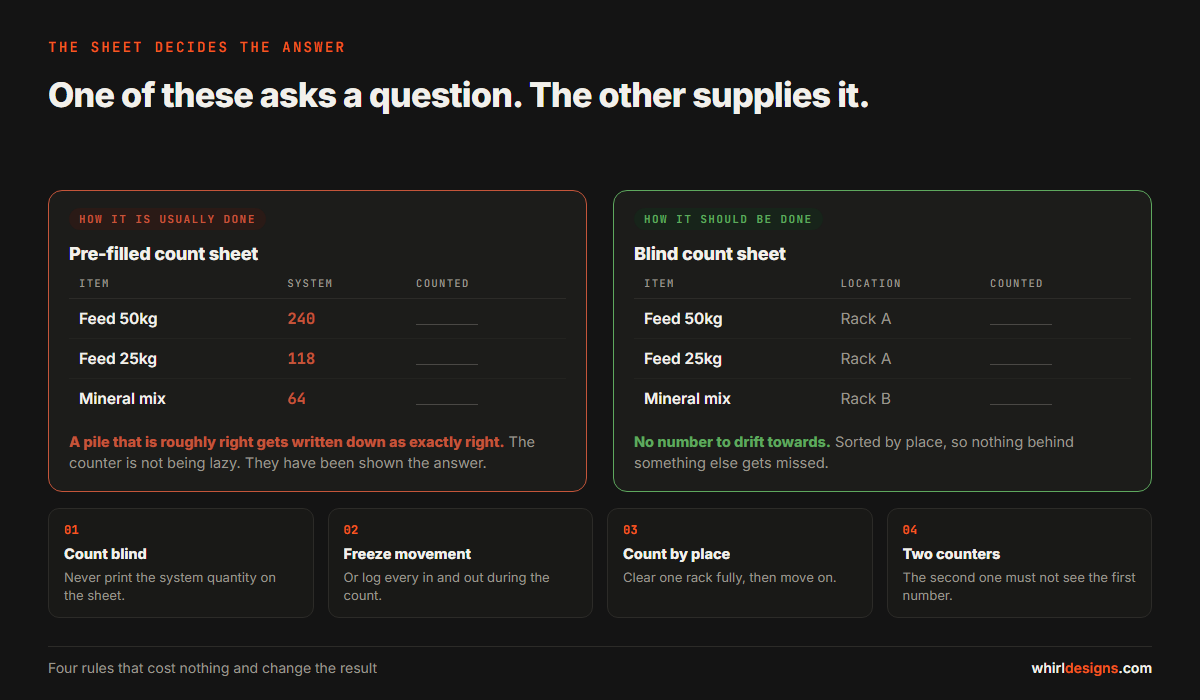
Count blind. The sheet the counter holds must not show the system quantity. If it does, a pile that is roughly right gets written down as exactly right, and your count has confirmed nothing. Print a sheet with the item and an empty box.
Freeze movement, or write down what moved. Nothing in and nothing out while counting. If that is impossible in a working business, which it often is, then keep a sheet at the door and write down every movement during the count, and adjust for it afterwards.
Count by place, not by list. Working down a list sends one person walking the whole godown for each line and guarantees that whatever is behind something else gets missed. Clear one rack or one corner completely, then move to the next.
Two people, and the second one does not know the first one's number. For anything valuable, count twice. If the two counts agree, you have a number. If they do not, count a third time before anyone says anything to anybody.
What to do with the difference
You have a real number now, and it is not the system number. There is a right way and a wrong way to close that gap, and most software makes the wrong way easier.
Do not type the new number over the old one. It feels like tidying up. What it actually does is destroy the only evidence you have. Next quarter you will find another difference and have no way to tell whether it is new or the same problem continuing, because the trail stops wherever somebody last corrected the figure by hand.
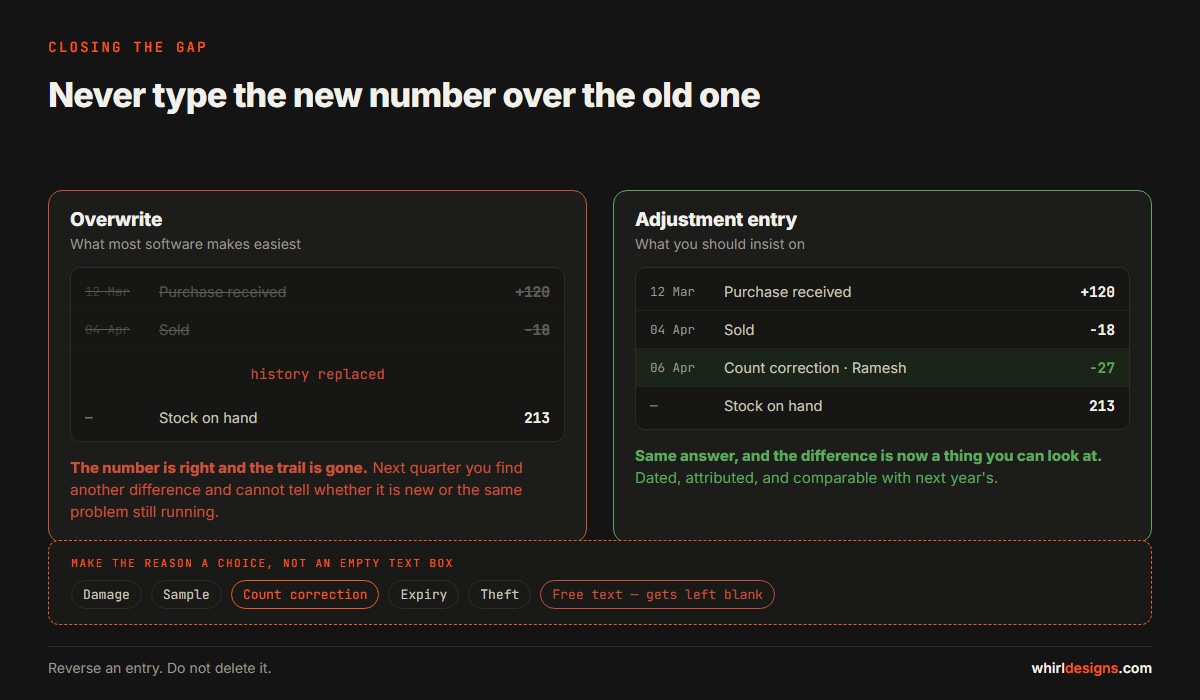
Post an adjustment instead. A dated entry that says the stock of this item moved by minus 27 on this date, for this reason, entered by this person. The old figure stays. The new figure is correct. And the difference itself is now a thing you can look at next year.
Make the reason a choice, not a free text box. Damage, sample, count correction, theft, expiry. Five options that somebody can pick in two seconds. A text box gets left empty, and an empty reason teaches you nothing.
This principle is worth carrying beyond stock. Accounting systems work the same way for the same reason. You reverse an entry, you do not delete it.
What the software should be doing for you
Some of this gap is process and some of it is the system you were sold. If your current one cannot do these, it is working against you:
- Stock per location, not one total. If you have two places, the software must know which stock is where, and a transfer must be two entries.
- A full movement history for any item. You should be able to click one product and see every in, out, transfer and adjustment, with dates and names, going back years.
- Reason codes on every adjustment, and a report that totals them. Damage worth tracking becomes visible only when it is added up.
- A real count mode that prints blind sheets, accepts the counted figures, and posts the differences as adjustments by itself.
- Unit conversion handled once, centrally, so nobody has to do arithmetic at the counter.
Most off-the-shelf billing packages sold to small businesses in this district do the first and stop. That is usually the point at which a business outgrows the package, and it is what billing and POS software or a fuller ERP build is actually for.
How often, realistically
Once a year, in a single enormous count, is the common practice and it is close to useless. The gap it finds is twelve months wide and tells you nothing about when or why.
Count a small, rotating slice instead. Ten items a week, chosen so that your fastest-moving and most valuable lines come round every month and the slow ones come round twice a year. It takes twenty minutes, nobody has to shut the shop, and a problem shows up while the people involved can still remember the week it happened.
A full count once a year is still worth doing. But by then it should be confirming what you already know, not telling you something new.
The number you are really after
A business that counts honestly ends up knowing something most of its competitors do not: what its stock is actually worth, and how much of it is sitting still. That is the figure that tells you what to reorder, what to discount, and what you are never buying again.
The 27 bags are not the point. The point is that for fourteen months, the business was making decisions on a number nobody had checked.
If you are weighing up whether your current system can be fixed or needs replacing, we look at that for businesses around Udupi, Mangaluru and the towns between, and we will tell you plainly when the answer is that it can be fixed. You can talk to us here.