Software for your own business
Best for: One company, with its own rules
- No sign-up, plans or renewals to build
- Quicker to finish and simpler to run
- Can become a product later, if others in your trade ask for it

SaaS product development · From Udupi, across India
We build subscription software that many businesses sign up for, each with its own users, data and plan, and we keep looking after it once it is live. Two products of our own are already live, and our studio in Udupi is open to visit.
In short
SaaS product development is building one piece of software, sold as a service, that many businesses sign up for and use by subscription, instead of software made for a single company. Each business keeps its own users and data inside the shared system. Whirl Designs builds SaaS products in Udupi, coastal Karnataka, for founders across India, and runs two industry products of its own on its ERP Sutra platform.
Start here
A SaaS product is harder to get right than software for one company, because strangers must sign up, pay and trust it with no one there to explain it. So the first question is whether you need one at all.
Best for: One company, with its own rules
Best for: Many businesses that do the same work
Best for: A problem many tools already solve well
Not sure which card fits? Most founders are not at first, and sorting that out is what the first call is for.
Our work
ERP Sutra
Software products · Karnataka
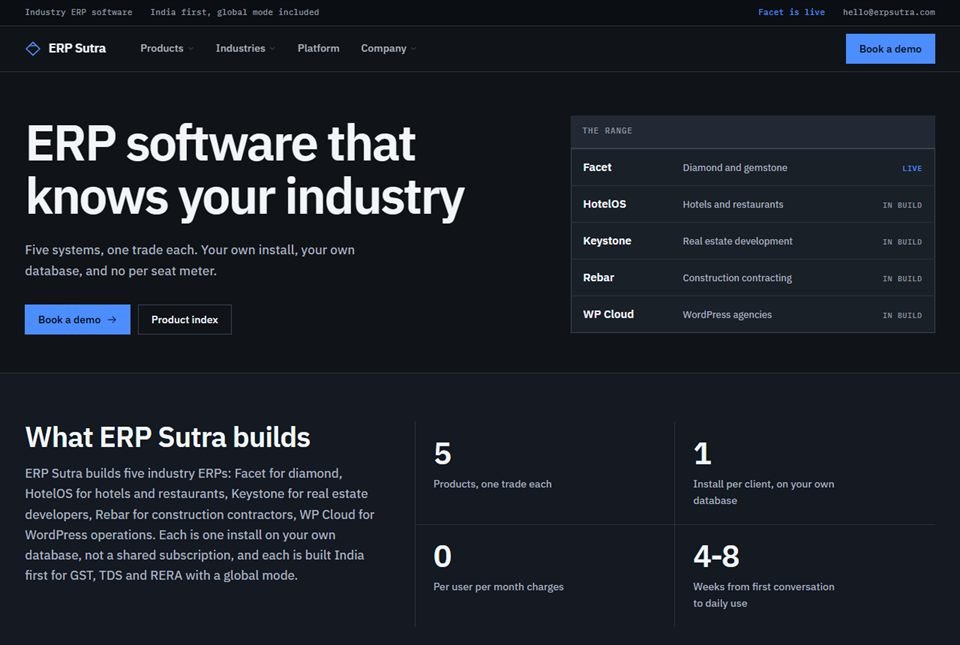
ERP Sutra is our own product arm, not a client project. It is one shared platform layer with two industry ERPs built on top: Facet for diamond and jewellery manufacturing, and Rebar for reinforcement-steel contractors. Both are live with paying users, rather than sitting in a pitch deck.
Sign-in, roles, the audit trail and backups were solved once, in the shared layer, so each product did not have to build them again. The platform runs on ordinary shared hosting rather than a fleet of servers, and the restore procedure has been drilled for real, not assumed.
Also built by us
What you get
The feature you are excited about is often the smaller part of the work. These six pieces decide whether a business can sign up, pay and trust you with its data. Each one is in the written plan.
How it runs
Real customers use the product before it is finished. That is how the right features get chosen, and the wrong ones get dropped.
We start with who will pay and how they work today. If one or two of them can join a call, the plan gets sharper straight away.
One core job, the six pieces above, and a list of what waits for later. Nothing is built until you have signed off on it.
Two or three future customers click through a mock-up of the main screens and say what is missing, while a change still takes minutes, not weeks.
A small group uses a new build every week or two, so most problems surface before sign-up opens to everyone.
Payments, invoices, welcome emails and the admin console go live, on hosting and gateway accounts in your company's name.
Usage numbers and support requests decide what gets built next, and the people who wrote the first version keep improving it.
Not a fit
We would rather say this on the first call than halfway through the build.
Questions
Plan on three to five months for a first version that businesses can sign up for and pay for. What makes it longer is the number of user roles, connections to other software such as Tally or a courier service, and heavy reports. A few early users are on the product from about halfway through, well before sign-up opens to everyone.
A SaaS MVP, or minimum viable product, is the smallest version a business will pay to use: one core job done well, plus sign-up, roles, billing and a way to ask for help. Extra reports, more roles and links to other software wait until paying users ask for them. A simple test: if a feature would not change a buyer's mind about signing up, leave it for version two.
Multi-tenant SaaS is one system shared by many customer businesses, where each business, called a tenant, can only ever see its own records. Before launch we create test accounts for two businesses and try to reach one's invoices, reports and files from the other, through every screen and export. Sign-up opens only when every attempt fails.
Yes, we connect an Indian payment gateway so your customers can renew by UPI AutoPay or card auto-debit, and the system tries again when a renewal payment fails. Each charge produces a GST invoice with your GSTIN, and the customer's GSTIN when they have one. A refund or a downgrade gets a credit note linked to the original invoice, rather than an edited invoice.
Your company does. The code and the customer data belong to you, and the hosting and payment gateway accounts are opened in your company's name, not ours. If you later hire your own developers, they get the code and written notes on how the product runs, where it is hosted and how to restore it.
Yes, if it grows in steps. The first version goes on hosting that suits its first customers, and ERP Sutra's two products, both with paying users, run on ordinary shared hosting. As use grows, the same code moves to a private server of its own (a VPS), then to bigger ones, and we warn you before the current hosting reaches its limit. Hosting can stay in India if your customers need that.
Often, yes, whether we built it or someone else did. We first read the code, check its backups and security, and give you a written report. Software made for one company then needs three things before others can use it: every record labelled with the business it belongs to, a way to sign up, and billing. Urgent faults get fixed before any of that starts.
Yes. Our studio is in Udupi, and founders from Manipal, Mangaluru, Karkala and Kundapura are welcome to come in for planning sessions. Founders elsewhere in India work with us over video calls and shared screens, with the same written plan and the same regular releases.
Worth reading first
Clean, documented, tested code on a modern, proven stack — the foundation that keeps your saas & product development fast and dependable for years.
Ready when you are
Describe the businesses you want to sell to and the job the product does for them, and you will get a written plan for version one.