AI agent development · From Udupi, across India

AI agents that ask before they act

We build AI agents that do one named job inside your own systems, such as sorting enquiries, drafting replies or reading supplier bills, and then wait for a person to approve their work. Built and looked after from our studio in Udupi.

Demo screen with made-up data.
One named job
not an assistant that tries to do everything
A person approves
before a reply or entry leaves the system
Inside your systems
reads your own stock, orders and records
Accounts in your name
AI account, instructions and logs are yours

In short

What is an AI agent for a business?

An AI agent is software that does one business job in several steps: it reads a request, looks up the business's own records, such as stock or orders, and prepares a reply or an entry. Whirl Designs, a studio in Udupi, builds agents like this for businesses in coastal Karnataka and elsewhere in India, and each one waits for a person to approve its work before anything goes out.

Updated · Whirl Designs, Udupi

Start here

A fixed rule, an assistant, or an agent?

Not every repeat job needs AI. Routine work can come off your team's desk in three ways, and we build the simplest one that does the job.

A fixed rule

Best for: The same steps every time, no judgement needed

  • A payment reminder, a daily stock report, an alert when an order lands
  • Runs on a schedule or a trigger, with no AI in it at all
  • Cannot invent an answer, because it only does what it is told

An assistant that answers

Best for: Questions answered from your own written content

  • Replies from your FAQs, service pages and policies
  • Passes the chat to your staff when it has no answer
  • Only reads; it changes nothing in your systems

An agent that acts, with approval

Best for: Jobs that need reading, checking and a draft

  • Reads the request and looks up your stock, orders or records
  • Drafts the reply, the entry or the follow-up message
  • Waits for a person to approve before anything goes out

When a fixed rule can do the job, we will tell you and build that instead, even if you came to us asking for AI.

Our work

No client agent to show you yet

No client of ours runs an AI agent yet, so this page has no client project to show. The approval screen at the top is a demo, and the cement order in it is made up. What we can point to is smaller and our own: the assistant on our website, which you can try.

It already has two of the parts an agent needs. It works only from this site's own writing, about 260 passages of service pages, FAQs and articles, and when a question matches a written FAQ closely, it gives that FAQ's answer unchanged instead of writing a new one. It also knows when to stop: a question it cannot answer is sent to a person on Telegram, whose reply lands back in the visitor's chat. What it does not do is act inside a business system. That part, with an approval step in front of it, is what a client agent adds.

  • Padmavathi Tours & Travels: instant enquiry alerts on the owner's phone, the same kind of message an agent sends when a draft needs approval
  • Jayalaxmi Jewellers: capability-based staff permissions, where every role is given only the tasks it needs, the same rule an agent's own login follows
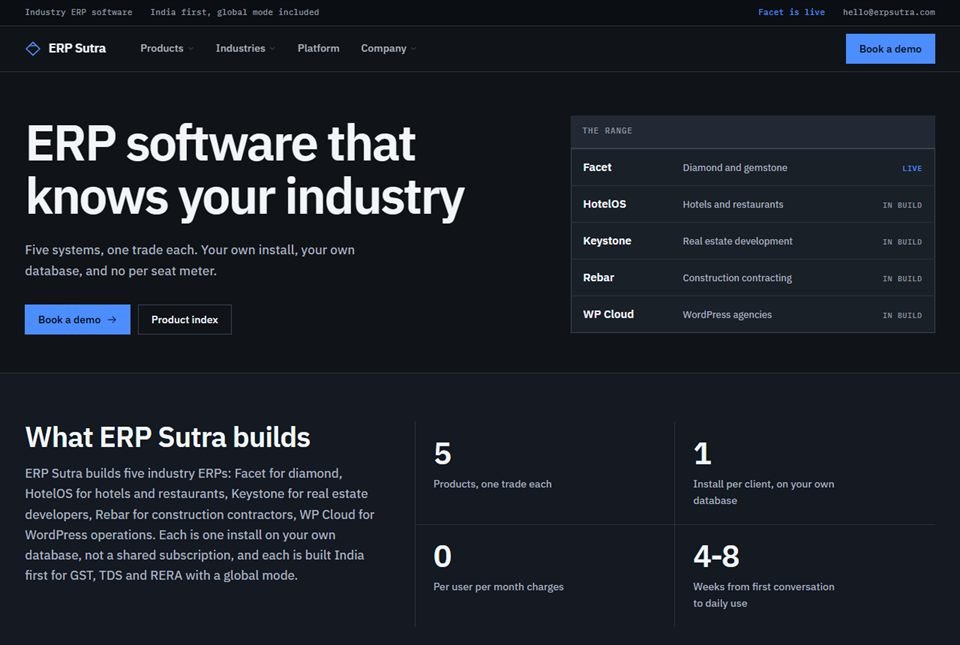
  • ERP Sutra: logins, roles, audit records and backups built once into a shared platform layer, the kind of record-keeping an agent's run log depends on

Closest projects

What you get

Six parts that keep an agent safe

The AI model is only one part. The pieces around it decide whether the agent can be trusted with your customers. Every one of them is agreed in writing first.

  1. A written job descriptionWhat the agent does, what a good result looks like and what it must never do, agreed with the person who does the job today.
  2. Only the access it needsThe agent gets its own login with the narrowest role. It can read stock and draft a reply, but it cannot delete a bill, give a refund or change an amount.
  3. A handover when it is unsureWhen a record is missing or a request is unusual, it passes the case to a named person with what it found so far, instead of guessing.
  4. The approval screenThe draft, the records it checked, and Approve and Edit buttons, on a phone or at the desk. Nothing that speaks for your business goes out until someone taps Approve.
  5. A log of every runWhat came in, what the agent read, what it drafted, who approved it and when. If a reply was wrong, the log shows where it went wrong.
  6. A test set that staysThe past cases your team marked during testing are kept, with the answer staff actually gave. Every change to the agent, and every new AI model, is checked against them before it goes live.

How it runs

From one idea to daily use

Each step ends with something your team can see and check before the next one starts.

  1. Pick one job

    Sorting enquiries, drafting replies to order requests, following up on enquiries that went quiet, or reading supplier invoices into purchase entries. We choose the one that takes the most staff hours and where a mistake would do the least harm, then watch the person who does it today.

  2. Try it on past cases

    A first version works through real enquiries or documents from the last few weeks, away from customers. You mark each draft right or wrong, and we fix what it gets wrong.

  3. Connect it to your software

    It gets read-only access to your stock, orders or billing. Anything it writes, such as a purchase entry from a supplier bill, stays a draft until a person saves it.

  4. Go live with approval on

    Every draft waits for a person. Your team works from the approval screen for a few weeks, and the log shows what the agent got right and what they changed.

  5. Loosen only what earns it

    Sorting, labelling and internal notes can later run on their own if the log shows they are reliable. Replies about orders, and anything that touches money, stay behind approval.

  6. Looked after when the AI changes

    AI providers update and retire their models. When that happens, we run your test set again, fix what has changed and tell you before the new version goes live.

Not a fit

When an agent is the wrong answer

  • The job comes up only a few times a week. An agent needs a test set, a log and someone to look after it, and for a rare task that is more work than the task itself.
  • The information it would need is not written down. If stock lives in one person's head or a notebook, no agent can check it, so we would start by putting it into a system.
  • You want it to confirm orders, move money or make promises to customers with no one checking. In everything we build, those stay with a person.
  • You want it to replace your staff. An agent takes typing and looking-up off their day; the decisions stay with them.

5.0 on Google — read our reviews

Questions

Questions about AI agents

What is the difference between an AI agent and a chatbot?

A chatbot answers questions; an agent does a job. An agent reads a request, looks something up in your own system, such as stock or an order, and prepares the next step, like a reply or a purchase entry. Because it can reach your records, how its access is set up matters more than which AI model it uses. Ours get the narrowest access the job needs and stop for a person before anything is sent.

Can an AI agent make mistakes or invent answers?

Yes, AI models sometimes give a wrong answer in a confident voice, so we build every agent as if that will happen. Ours work only from your records and written content, give a written FAQ answer unchanged when a question matches it closely, and pass a case to a person when a record is missing instead of guessing. A person also checks every reply about an order before it goes out.

Is our customer data safe with an AI agent?

It can be, if what the agent sends and keeps is decided in writing before it is built. An AI model run by a provider such as Anthropic or OpenAI receives the text the agent passes to it, under that provider's terms, so we send only what the job needs and keep details like bank account numbers out where we can. We also agree what is kept and when it is deleted, because India's data protection law, the DPDP Act, covers the customer details an agent handles.

Can an AI agent reply to customers on WhatsApp?

Yes. The agent connects through the WhatsApp Business API, the official route that lets software send and receive messages on a business number. Customer messages reach the agent, and its drafts go out once someone approves them. WhatsApp lets a business reply in its own words within 24 hours of the customer's last message; after that, and for messages your business sends first, such as reminders, it needs a template approved by Meta. We built a jeweller's retail system that sends receipts and reminders this way.

Can an AI agent reply in Kannada?

Yes. Current AI models read and write Kannada well enough for everyday replies, including messages typed in a mix of Kannada and English, or Kannada written in English letters. The agent answers in the language the customer used. Before launch, staff who speak Kannada read test drafts in both languages and mark any that sound stiff or wrong, and the approval step catches the rest.

How long does it take to build an AI agent?

A first agent for one job usually takes four to eight weeks. That covers writing the job down, testing on your past cases, connecting to your software and a few weeks of running with approval switched on. Older software with no way to connect can add time, and we will tell you that at the start rather than halfway through.

Can an AI agent work with Tally, our ERP or billing software?

Often, yes. Tally can share data with other programs while it is open on your own computer, and many ERP and billing tools offer their own way in for other software. What your version and setup allow decides how the agent reads from it, so that is the first thing we look at. If the records live only in spreadsheets, we may suggest moving the key parts into a proper system first.

Do we need our own AI team to run an agent?

No. You need one person who knows the job well enough to check the agent's drafts in the first weeks, and nobody who writes code. We pick the AI model, usually Claude from Anthropic or a model from OpenAI, and look after the tests and connections. The AI account is opened in your business's name, so the account, the agent's instructions and its logs stay yours if you ever change developer.

Worth reading first

SOFTWARE DEVELOPMENT

Engineering you can build on.

Clean, documented, tested code on a modern, proven stack — the foundation that keeps your ai agent development fast and dependable for years.

Claude APIOpenAI APIPythonPHP 8WhatsApp Business APIREST APIsPostgresQueue workersClaude APIOpenAI APIPythonPHP 8WhatsApp Business APIREST APIsPostgresQueue workersClaude APIOpenAI APIPythonPHP 8WhatsApp Business APIREST APIsPostgresQueue workersClaude APIOpenAI APIPythonPHP 8WhatsApp Business APIREST APIsPostgresQueue workersClaude APIOpenAI APIPythonPHP 8WhatsApp Business APIREST APIsPostgresQueue workersClaude APIOpenAI APIPythonPHP 8WhatsApp Business APIREST APIsPostgresQueue workersClaude APIOpenAI APIPythonPHP 8WhatsApp Business APIREST APIsPostgresQueue workersClaude APIOpenAI APIPythonPHP 8WhatsApp Business APIREST APIsPostgresQueue workers
app/services/report.ts
export async function buildReport(range) { const data = await db.orders.between(range); return { revenue: sum(data), growth: 0.18 }; } ✓ tests passed · deployed to prod

Ready when you are

Let's build something that lasts.

Tell us the one job that takes up most of your team's day, and we will write down how an agent would handle it and where a person checks its work, or tell you honestly that a simpler tool will do.

50+
projects shipped for local & global clients_
100%
of the code is yours to keep_
9
real, live projects on our work page — from our Udupi studio_
Whirl Designs assistantAnswers from this site · not a person
Ask about what the studio builds, how a project runs, or what would suit your business. I answer from this site, and I can pass you to the team any time.
WhatsApp us