
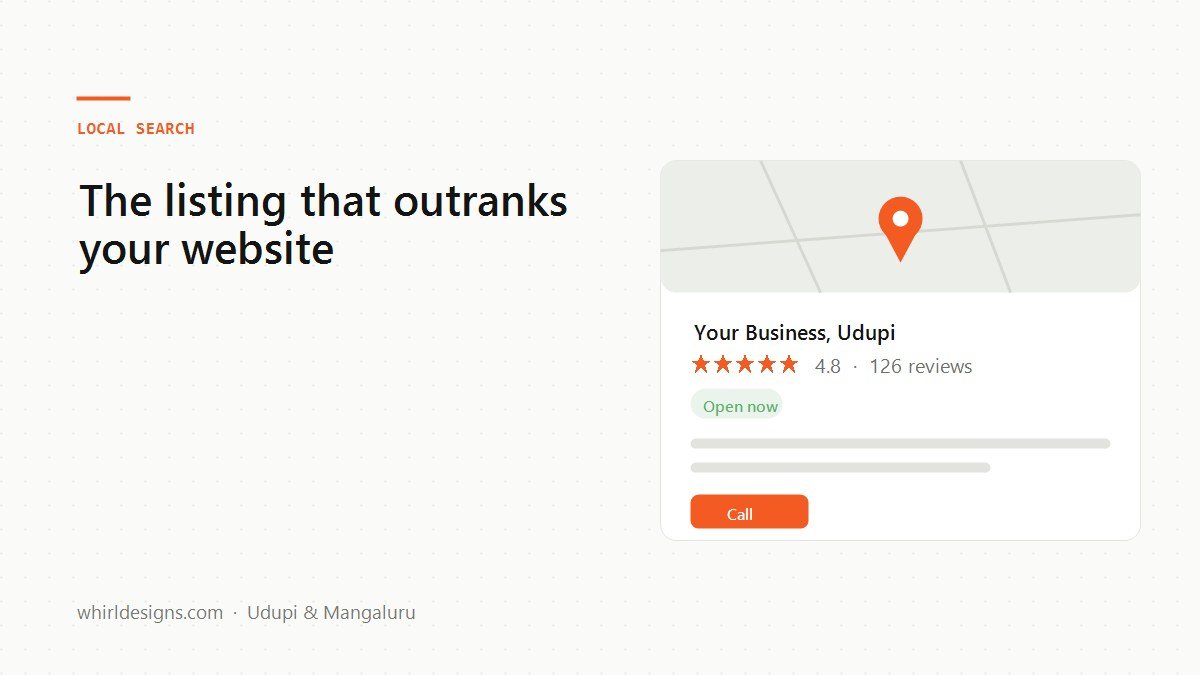
Here is an uncomfortable fact for anyone who has just paid for a website. When somebody in Udupi searches "AC service near me" on their phone, the first thing they see is not a website. It is a map with three businesses on it, each with a star rating and a call button. Most people tap one of those three and never scroll.
That box is the local pack, and what feeds it is your Google Business Profile — the free listing, not your website. For a business that serves people who are physically nearby, the listing is doing more work than the site. It is also, in our experience, the thing most likely to be half-finished.
Finish the boring fields first
Google ranks complete listings above incomplete ones, and most listings are missing the same handful of things:
- Primary category. The single most important field. "Air conditioning repair service" and "Electrician" surface for completely different searches. Choose the one that matches what you want to be called for, not the one that sounds most impressive.
- Secondary categories. Add the genuinely relevant ones and stop. Five unrelated categories dilute you.
- Hours, including holidays. "Open now" is a filter people actually use. A listing with no hours never passes it.
- Services and products. Each one is a separate chance to match a search.
- Photos. Real ones, of the actual premises, taken on a real phone. More on this below.
Get your name, address and phone identical everywhere
This is the part that quietly sinks listings. Google is trying to work out whether the "Sri Ganesh Motors" on Justdial, the one on your website footer and the one on the map listing are the same business. It does that by comparing name, address and phone number — NAP, in the jargon.
If your listing says "Shop No. 4, Kalsanka, Udupi 576101" and your website footer says "Near Kalsanka circle, Udupi", those are two different strings. Not fatal, but every mismatch is a small vote against you.
Pick the exact wording on your Google listing and copy it, character for character, into your website footer, your contact page, your invoices and every directory you appear on. It is an hour of tedium that pays for itself.
Reviews: ask, do not buy
Review count and recency both feed local ranking, and reviews are the single strongest influence on whether somebody taps your listing rather than the one above it. A business with 4.6 from 90 reviews beats a 5.0 from 3 every time — the second looks like friends and family, because it usually is.
What works, in order:
- Ask at the moment of relief. Right after the AC works again, the car is delivered, the function goes well. Not a week later.
- Send the direct link. Google gives you a short review link in your profile dashboard. Put it in a WhatsApp message. Every extra tap loses people.
- Reply to all of them. Especially the bad ones, politely and factually. Prospects read the replies more carefully than the reviews — a calm reply to an angry review sells better than a wall of five stars.
Do not buy reviews. Google's detection has become good enough that the realistic outcome is a suspended listing, and a suspended listing is far worse than a mediocre one.
Photographs, honestly
Listings with real photographs get meaningfully more calls than listings with stock images, and everybody can tell the difference instantly. A slightly imperfect photo of your actual shopfront, your actual workshop, your actual staff, beats a polished stock photo of a generic office every time — because the customer is trying to work out whether they will recognise the place when they arrive.
Add the storefront from the road, the interior, the team, and the work itself. Refresh them a couple of times a year. Geotagging images is not necessary; Google strips most of that metadata anyway.
Use Posts, because almost nobody does
Google Business Profile lets you publish short updates — offers, events, new services — that appear on the listing. They expire, they take five minutes, and in most local markets in coastal Karnataka almost none of your competitors bother. A listing that has posted this month looks alive; one that last posted in 2023 looks closed.
Where the website still matters
None of this means the site is decoration. The listing and the site work together:
- Google checks whether the site backs up what the listing claims. Same address, same phone, same services.
- The listing gives you a headline and a phone number. The site is where somebody decides you are competent — prices, process, photos of your work, answers to the questions they are too polite to ask.
- Anything longer than a sentence has to live on the site. The listing has no room for it.
The right way to think about it: the listing wins the search, the website wins the decision.
A one-hour checklist
- Claim and verify the listing if you have not.
- Set the primary category deliberately.
- Fill in hours, services, and a description that names the towns you serve.
- Copy the address into your website footer word for word.
- Upload eight real photographs.
- Save the review link into your phone and start asking.
- Reply to every review that is already there.
Do that and you will be ahead of most local businesses in the district, for the cost of an afternoon and nothing else.
Common questions
Is Google Business Profile more important than a website?
For a business serving nearby customers, usually yes. The map pack appears above the organic results on a phone, and most people tap one of those three listings without scrolling. The listing wins the search; the website wins the decision that follows.
How do I rank higher in the Google map pack?
Complete the listing properly, set the right primary category, keep name, address and phone identical everywhere they appear, add real photographs of your premises, collect reviews steadily and reply to all of them. Completeness and review recency both feed local ranking.
Should I buy Google reviews?
No. Google detects purchased reviews well enough that the realistic outcome is a suspended listing, which is far worse than a modest rating. Ask real customers at the moment the job goes well, and send them the direct review link over WhatsApp.