
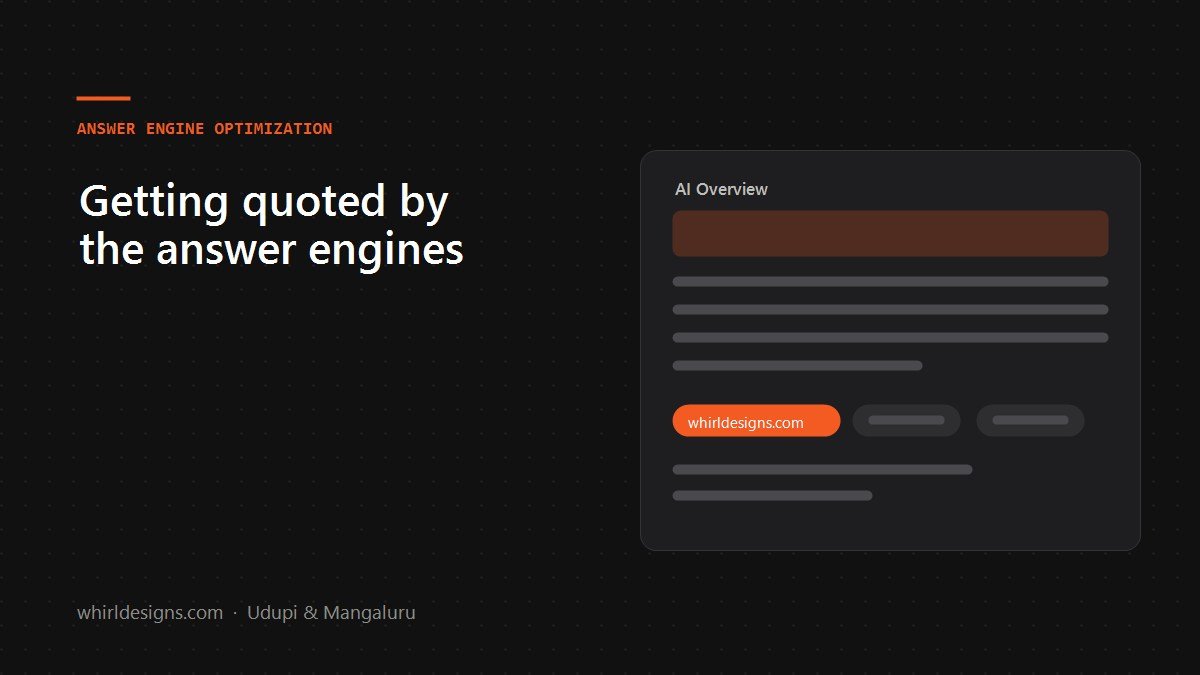
Ask Google "best tempo traveller hire in Udupi" today and you may never see a list of ten blue links. You get a written answer at the top, assembled from a handful of sources, with small citation chips beside it. Ask ChatGPT the same question and you get an answer with no links at all unless it decides to search.
This is the shift that matters for small businesses right now. For twenty years SEO was about being one of ten results. Increasingly it is about being one of three sources an answer engine chose to read. That is a much narrower doorway, and the things that get you through it are not quite the things that got you ranked.
What an answer engine is actually doing
Whether it is Google's AI Overviews, ChatGPT with search, Perplexity or Claude, the mechanism is broadly the same. The system takes the question, finds a small set of candidate pages, reads them, and writes a summary citing the ones it leaned on. Two consequences follow, and they are the whole game:
- It has to be able to read you. Content that only appears after JavaScript runs, or that sits behind a slow page, frequently does not make it into the candidate set.
- It has to be able to lift a clean answer. A model summarising ten pages will quote the one that states the fact plainly. Prose that circles the point for four paragraphs loses to a page that answers in two sentences.
That second point is the one most sites get wrong, and it is the cheapest to fix.
Write the answer, then the article
The single highest-return change is structural. Take the questions your customers genuinely ask and make each one a heading, with a direct answer in the first 40 to 80 words underneath it. Not a preamble. Not "in today's competitive landscape". The answer.
Compare these two openings for a page about tempo traveller hire:
Weak: "Travelling with a large group can be a wonderful experience, but choosing the right vehicle is often a challenge for families in coastal Karnataka…"
Strong: "A 16+1 Force Urbania seats sixteen passengers plus the driver and costs less per head than three cars for the same trip. From Udupi it is the usual choice for temple circuits to Kollur, Murudeshwar and Dharmasthala."
The second version can be quoted verbatim. The first cannot be quoted at all, because it does not say anything yet. Answer engines reward the second and ignore the first, and so, incidentally, do human readers.
Facts beat adjectives
Models are built to avoid confidently stating things they cannot support. Pages full of "leading", "premium" and "world-class" give them nothing to hold on to. Pages with specifics — seat counts, distances in kilometres, opening hours, districts served, what is included in a price — give them quotable material.
This is why a page that says "we serve Udupi, Karkala, Kundapura and Byndoor, with drivers who speak Kannada, Tulu and Konkani" outperforms one that says "we serve coastal Karnataka with experienced staff". The first is a fact an answer can carry. The second is a claim it has to launder.
Structured data is how you speak the machine's language
Schema.org markup is a small block of JSON in your page that states, unambiguously, what the page is about: that this is a LocalBusiness, that its address is X, that it is open at these hours, that these are the questions and answers on the page.
Answer engines are not obliged to use it, but it removes guesswork. If your opening hours are only in a picture of a signboard, no model will ever read them. If they are in OpeningHoursSpecification, every one of them can.
The three worth adding to almost any Indian small-business site are:
- LocalBusiness — name, address, phone, hours, area served. The address must match your Google Business Profile character for character.
- FAQPage — for the question-and-answer blocks you have just written.
- Service or Product — one per thing you actually sell.
Let the AI crawlers in — deliberately
Your robots.txt decides who may read your site. Most are written for Googlebot and say nothing about the others, which leaves crawlers such as GPTBot, OAI-SearchBot, ClaudeBot, PerplexityBot and Applebot to interpret the silence.
If you want to be cited, name them and allow them explicitly. It costs nothing and removes any ambiguity:
User-agent: GPTBot
Allow: /

User-agent: ClaudeBot
Allow: /

User-agent: PerplexityBot
Allow: /
A growing number of sites also publish an llms.txt — a plain-text summary of what the business does, which services it offers and how to contact it, written for machines rather than people. It is not an official standard, and no engine is obliged to fetch it. It is cheap enough to be worth having anyway.
The uncomfortable part: you may get fewer clicks
Worth saying plainly, because most articles on this topic will not. If an answer engine reads your page and tells the user what they wanted to know, they may never visit your site. That is a real cost, and pretending otherwise helps nobody.
Two things make it worth doing anyway. First, being the cited source is itself a form of advertising — people remember which business the answer named. Second, the queries that end in a phone call rarely end in the AI Overview. Someone asking "what is answer engine optimisation" is reading. Someone asking "tempo traveller hire Udupi contact number" is buying, and that person still clicks.
What to do this month
- Write down the ten questions customers actually ask you on the phone.
- Make each one a heading on the relevant page, with the answer in the first two sentences beneath it.
- Replace every vague claim on your home page with a specific, checkable fact.
- Add LocalBusiness and FAQPage structured data, with your address matching your Google listing exactly.
- Name the AI crawlers in your robots.txt and allow them.
None of this requires a rebuild, and all of it makes the site better for human readers too. That is the useful thing about answer engine optimisation: unlike a lot of SEO, the work that pleases the machine is the same work that respects the reader.
Common questions
What is answer engine optimization?
Answer engine optimisation is the practice of structuring a website so that AI systems — Google AI Overviews, ChatGPT, Claude and Perplexity — can read it, quote it accurately and cite it as a source. It overlaps with SEO but optimises for being the source of a written answer rather than one of ten links.
How is AEO different from SEO?
SEO tries to rank a page among ten results. AEO tries to make a page the source an AI quotes when it writes the answer. In practice that means direct answers under question headings, checkable facts instead of adjectives, structured data, and explicitly allowing AI crawlers in robots.txt.
Will AEO reduce my website traffic?
It can. If an answer engine tells someone what they needed, they may never click through. The trade is worth it because being the cited source builds recognition, and high-intent searches — someone looking for a phone number or a price — still end in a visit.