
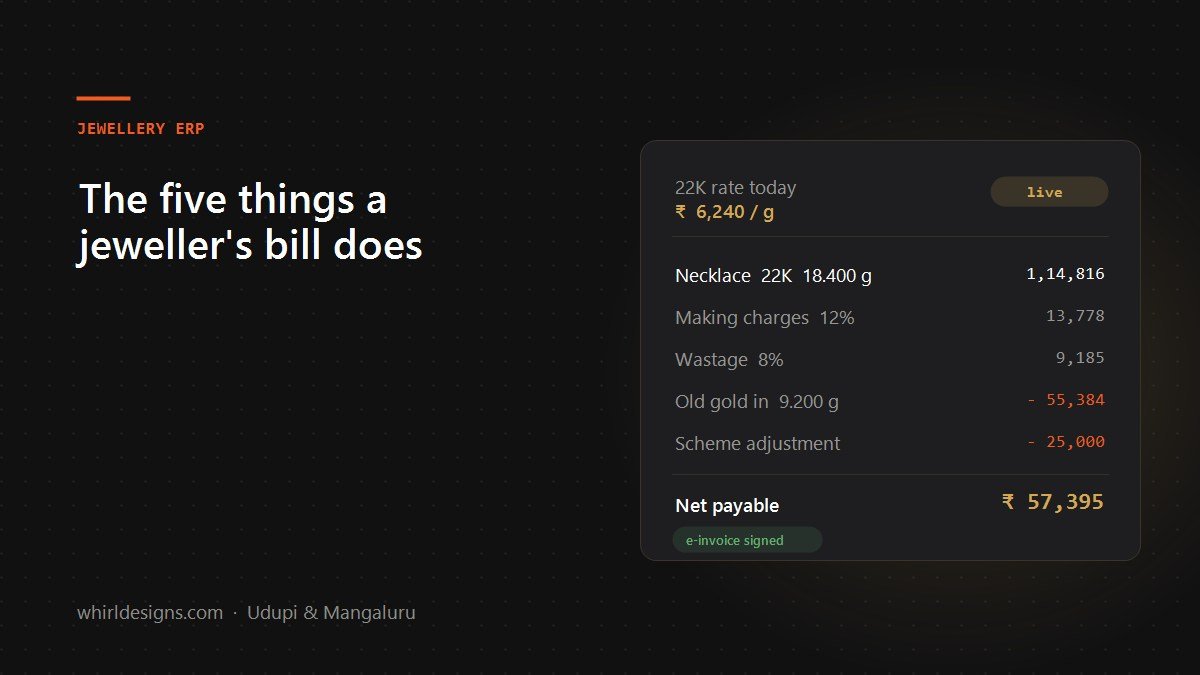
Walk into most jewellery shops in coastal Karnataka and the billing runs on some combination of Tally, a rate written on a whiteboard, a scheme register in a hardbound book, and a karigar's name pencilled against a packet of gold that left the shop three weeks ago. It works. It has worked for decades.
It stops working at a very specific point: when the owner can no longer hold the whole business in their head. That is usually not a turnover figure. It is the day a second counter opens, or a son or daughter joins, or the karigar list grows past the number of people you speak to daily.
Why is a jewellery bill so different from any other bill?
Because five things happen on a single invoice that no ordinary retail software models, and they interact.
1. The rate moves while the customer is standing there
Gold is priced per gram at a rate that changes daily and sometimes intraday. A quotation given at 11am can be wrong by evening. Any system that stores a fixed price against a product is already lying — the item's value has to be computed from a live rate, its purity and its weight at the moment of billing, and the rate used must be recorded on the bill so the sale can be explained six months later.
2. Old gold comes back as part payment
The customer brings in an old chain. It is weighed, tested, a deduction is applied for purity and solder, and the value is set against the new purchase. That is not a discount and it is not a refund. It is an inward purchase of metal and an outward sale of an ornament happening on the same document, with tax treated differently on each side, and it changes your stock in two directions at once.
Software that treats it as "discount: ₹55,384" loses the metal. And the metal is the business.
3. Savings schemes are money you have not earned yet
A customer pays ₹5,000 a month for eleven months and takes gold in the twelfth. Until they do, that money is a liability, not a sale. It sits against a scheme account, it may carry a bonus instalment, and when it is finally redeemed it becomes a tender on a bill — reducing what is payable without being a discount on the ornament.
Get this wrong and two things break. Your books overstate income for a year, and a cancelled scheme has no clean path to refund because the money was never held as a liability in the first place.
4. Your stock spends half its life in someone else's workshop
Karigar job work is the part that spreadsheets handle worst. You issue 42 grams to a goldsmith. Weeks later 39.6 grams comes back as a finished piece, with an agreed wastage and a making charge. In between, that gold is yours, it is not in your shop, and it is not lost.
Very few businesses can tell you, on demand, exactly how much metal is out with karigars right now and against which issue slips. That number is often several lakh rupees, and it is usually held in one person's memory.
5. Making charges and wastage are per item, not per bill
One piece carries 12% making, another a flat rate per gram, a third was negotiated. Wastage differs by item type. Both have to be visible on the bill because customers ask, and both have to be recoverable in reporting because they are where the margin actually lives.
Is Tally not enough?
Tally is excellent, and you should keep it. It is your book of accounts, your GST returns, your ledgers. Nothing written here suggests replacing it.
What Tally does not do is run your counter. It does not price an ornament from a live rate and a weight, hold a scheme member's eleven instalments, track metal out with a karigar, or produce a bill that shows old gold in and scheme adjustment on the same page. It was never meant to. Asking Tally to do it is why the whiteboard and the scheme register still exist.
The right arrangement is an ERP that runs the shop floor and hands clean figures to Tally for the books — not two systems arguing about the same numbers.
Where does an item in your stock actually come from?
This sounds like a philosophical question and it is the most practical one in the whole system.
In most small-shop software, staff can create a stock item by typing it in. Once that is possible, stock and purchase records drift apart within weeks, and no reconciliation is ever possible again — because there is no answer to "where did this 14 gram bangle come from?"
In a system built properly, the only way an item comes into existence is by being bought. Purchase, then goods-in, then it exists. Nobody can type a bangle into the stock list. It is a small rule that decides whether your stock figure means anything at all a year later.
What about HUID and e-invoicing?
Two compliance realities now sit on top of the trade.
HUID means hallmarked pieces carry a unique six-character identifier, which needs to be recorded against the item and printed on the bill. A stock system that tracks by category and weight alone cannot do this — it has to track individual pieces.
GST e-invoicing, if your turnover is above the threshold, means a B2B invoice has to be reported to the government portal at the moment of billing and come back with an IRN and a signed QR code before the bill is valid. Not at month end. At the counter.
That second one is deceptively hard, because the portal is not always available. When we built the e-invoicing path into the jewellery ERP we run, the retry queue took longer to get right than the integration itself — a shop counter cannot stop while a government portal is having a bad afternoon, and it must never print an invoice that looks registered when it is not.
What we built, and what it taught us
We build and run a jewellery ERP for a gold house trading since 1990, and a second, deeper system for diamond and jewellery manufacturing. Between them they cover billing at the counter, savings schemes, old-gold exchange, karigar job work with issue and return against wastage, stock by individual piece, GST e-invoicing with the QR code, and WhatsApp receipts and scheme reminders sent automatically.
Three things surprised us, and they are worth more to you than the feature list:
- The permissions mattered more than the features. Who may change a rate, who may approve an old-gold valuation, who may cancel a bill after printing. In a family business these conversations are uncomfortable and necessary, and software is a good excuse to have them.
- Cancellation is where systems break. Cancelling a bill that included a scheme redemption and an old-gold inward has to unwind all three cleanly, or you have quietly lost metal. We rewrote that path more than once.
- The staff decide whether it survives. If billing a walk-in customer takes longer than the old way, the system is dead by week two, whatever it can do. Speed at the counter beats every feature on a brochure.
How much does a jewellery ERP cost?
Less than people fear, if you start with one module, and far more than expected if you attempt everything at once. The honest advice we give every jeweller who asks:
- Start with billing. Live rate, weight, purity, making, wastage, old gold in. It is the busiest counter in the shop and the fastest to show value.
- Add schemes next, if you run them, because that is where the largest uncontrolled liability sits.
- Then karigar job work, which will probably tell you something uncomfortable about how much metal is out.
- Keep Tally. Feed it clean figures. Do not rebuild accounting.
Run each module alongside the old method for a month. When staff stop reaching for the register, move to the next one. Any vendor proposing a twelve-month rollout that goes live everywhere on the first of the month is proposing a project that will fail quietly and be blamed on the staff.
Do I need this if I run a single small shop?
Possibly not yet. If one person knows every scheme member, every karigar packet and every customer by name, that person is a better system than most software.
The moment to move is when that stops being true — a second counter, a second location, a family member joining, or the first time you cannot answer "how much gold is out with karigars?" without making a phone call. That question is a good test, and you can ask it of yourself this afternoon.
Common questions
Do small jewellers really need an ERP?
Not while one person can hold the whole business in their head. The point to move is when a second counter opens, a family member joins, or you can no longer answer how much metal is out with karigars without a phone call. Below that, a good register and Tally are genuinely fine.
Can Tally handle jewellery billing?
Tally is excellent for accounts, ledgers and GST returns, and you should keep it. It does not price an ornament from a live rate and weight, hold savings scheme instalments, or track metal issued to karigars. An ERP runs the counter and hands clean figures to Tally for the books.
How does software handle old gold exchange?
Correctly, it records old gold as an inward purchase of metal and the ornament as an outward sale on the same bill, with tax treated separately on each side and stock moving in both directions. Software that records it as a discount loses track of the metal, which is the actual asset.
How long does it take to implement a jewellery ERP?
Billing alone can be running in weeks. The mistake is going live everywhere at once. Start with billing, add schemes, then karigar job work, running each alongside the old method for a month. Twelve-month big-bang rollouts are how ERP projects fail quietly.