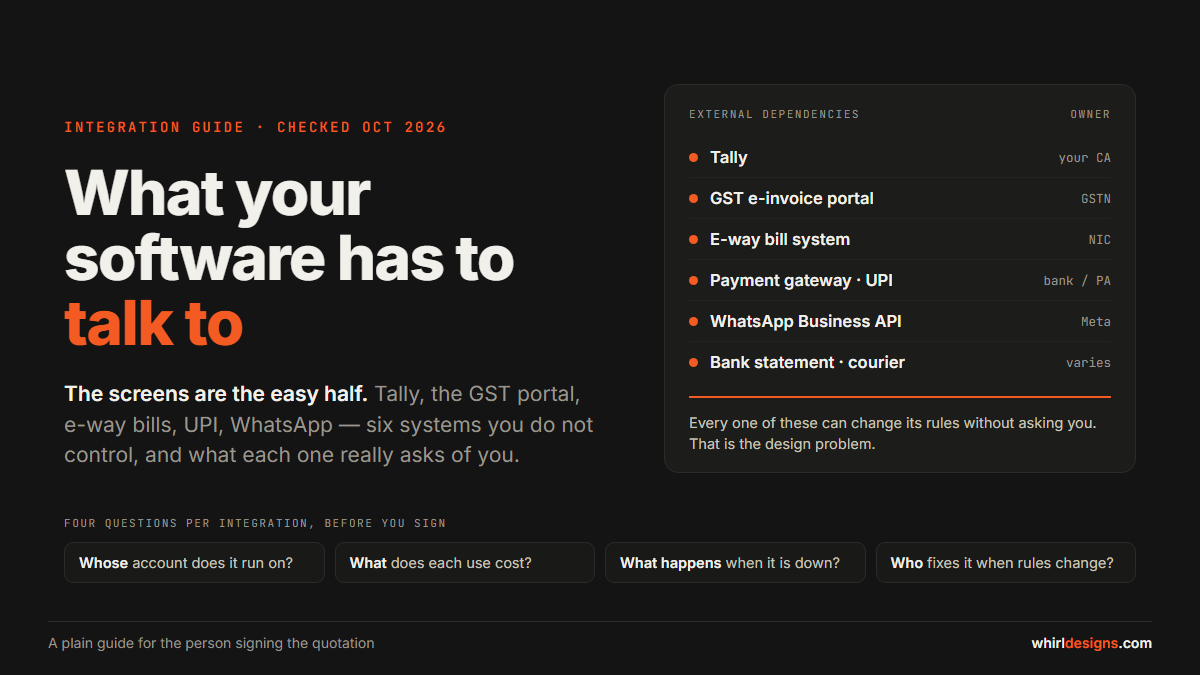
A software quotation usually describes the screens. Masters, billing, stock, reports, a dashboard. What it often does not describe is the part that takes the longest and breaks the most: everything the software has to talk to that you do not control.
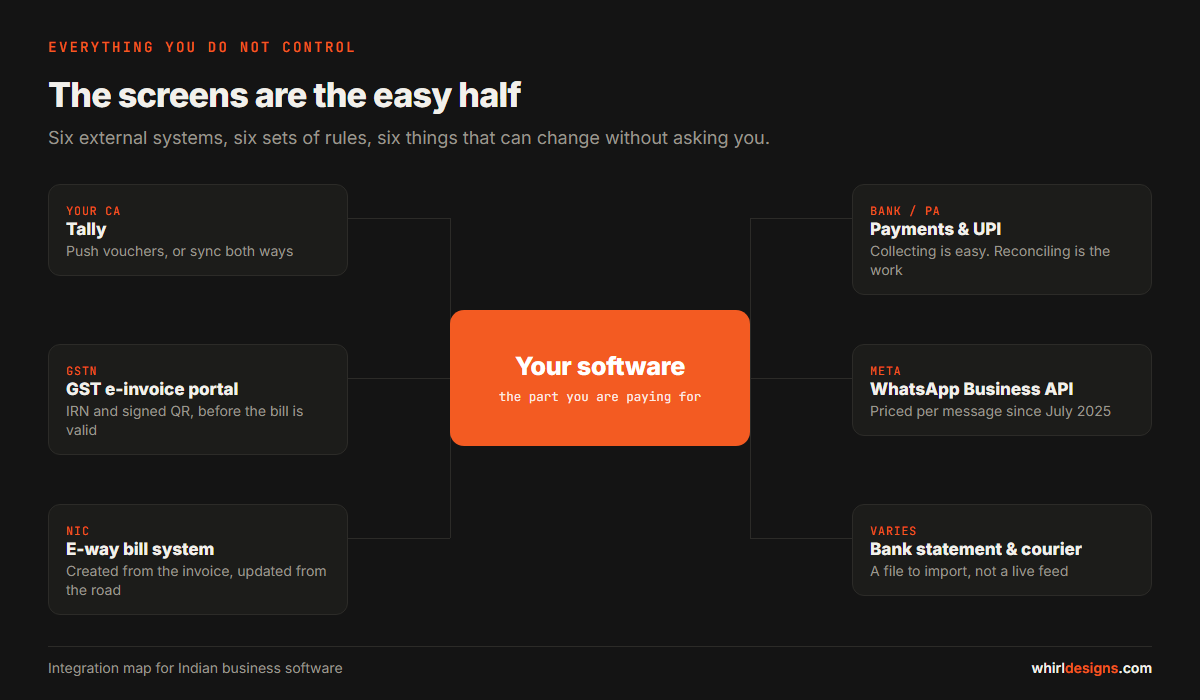
In India that list is longer than in most countries. A modest billing system for a distributor in Mangaluru may need to speak to the GST portal, produce an e-way bill, hand figures to the accountant's Tally, take money through UPI, send the customer a WhatsApp message and reconcile a bank statement — six external systems, each with its own rules, each able to change without asking you.
This article is a plain description of those six, what each one actually requires, and the questions to ask before you sign. It will not make you a developer. It will make you much harder to mislead.
1. Tally — the request that is really three requests
"It should sync with Tally" is the single most common line in a brief, and almost nobody means the same thing by it. There are three different asks hiding in that sentence, and they differ in cost by an order of magnitude.
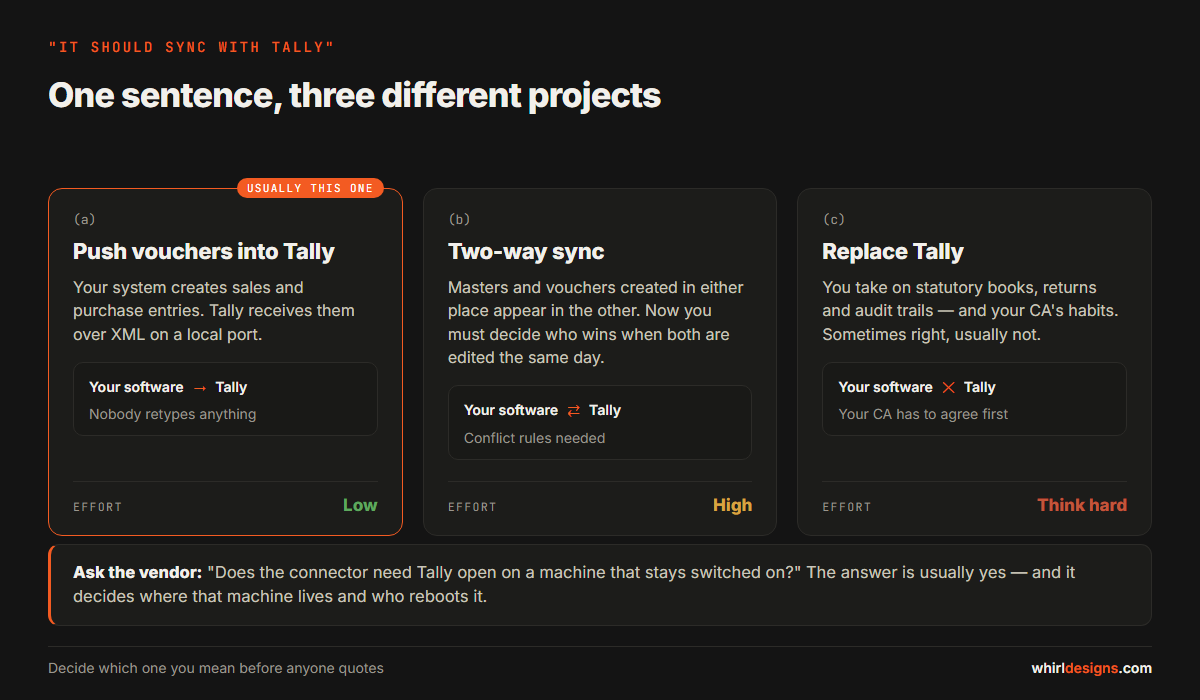
(a) Push vouchers into Tally. Your system creates the sales and purchase entries; Tally receives them. This is the common case and the cheapest. Tally accepts XML over a local HTTP port, so a system on the same network — or reaching it through a small connector — can post vouchers without anyone retyping them.
(b) Two-way sync. Masters created in either place appear in the other, and changes flow both ways. This is substantially harder, because now you need to decide who wins when the same ledger is edited in both systems on the same day. Most businesses who ask for this actually want (a) plus a nightly check.
(c) Replace Tally. Sometimes the right answer, usually not. Tally is doing your statutory books and your CA knows it. Replacing it means taking on returns, audit trails and your auditor's habits. Think hard before putting it in scope.
The practical question to ask a vendor: "Does the connector need Tally to be open on a machine that is switched on?" The answer is usually yes, and it determines where that machine lives and who reboots it.
2. The GST e-invoice portal
If your aggregate annual turnover has crossed ₹5 crore in any financial year since 2017-18, e-invoicing is mandatory for your B2B supplies. That threshold came down from ₹10 crore by Notification No. 10/2023 – Central Tax, with effect from 1 August 2023, and it has stayed there since.
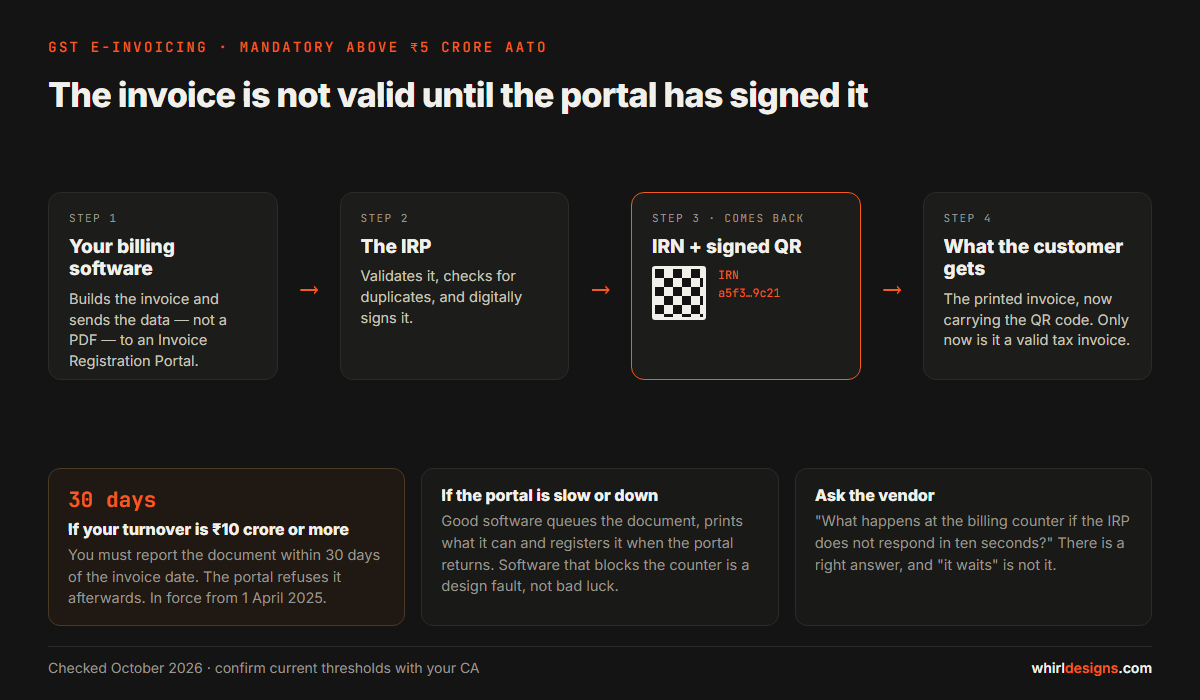
What this means for software is specific. You do not "send an invoice to the government". Your system sends the invoice data to an Invoice Registration Portal, which returns an IRN (a unique reference number) and a signed QR code. Only then is the document a valid tax invoice, and the QR code has to appear on what you hand the customer.
Two consequences owners usually learn late:
- There is a clock. Under a GSTN advisory of 5 November 2024, taxpayers with annual turnover of ₹10 crore or more must report a document to the portal within 30 days of the invoice date, with effect from 1 April 2025. The portal simply refuses it afterwards. Below ₹10 crore there is currently no such window, but you still cannot file GSTR-1 cleanly without the IRN.
- The portal is a dependency. If it is slow or down, and your software was written to block billing until it responds, your counter stops. Good billing software queues the document, prints what it can, and registers it when the portal returns.
Ask: "What happens at the billing counter if the IRP does not respond in ten seconds?" There is a right answer, and "it waits" is not it.
We have written a fuller explanation of the compliance side in GST e-invoicing, and what it does to your billing software.
3. E-way bills
Separate system, separate credentials, frequently confused with the above. Goods moving on a vehicle above a threshold value need an e-way bill carrying a transport document number and vehicle number.
The inter-state threshold is ₹50,000 across India. Intra-state limits are set by each state and genuinely differ — some states use a higher figure for certain goods — so this is one to confirm with your own commercial tax office rather than take from any blog, including this one.
For software, the thing that matters is that the e-way bill is generated from the invoice but updated from the road. Vehicle numbers change, trips get split, validity expires. A system that can only create an e-way bill and not update or cancel one will quietly push that work back onto a person with a phone.
4. Payments: collecting is easy, reconciling is not
Taking money online in India is a solved problem. Razorpay, PayU, Cashfree, CCAvenue and the rest will give you a checkout in a day, and UPI has made the collection side almost free compared to cards.
The work is on the other side. Three things are routinely under-quoted:
- Settlement is not payment. Money reaches your bank in batches, net of fees, a day or more later. Matching a bank credit of ₹47,312 against nineteen orders is the actual integration.
- Webhooks must be trusted carefully. The gateway calls your server to say a payment succeeded. If that endpoint does not verify the signature, anyone can call it too. This is the single most common security hole we find in e-commerce built cheaply.
- Refunds, partial refunds and failed-but-debited. The last one is a customer standing in front of you saying the money has gone. Your software needs a way to look it up by the gateway's reference, not just by your order number.
If the system collects money, ask to see the reconciliation screen before you approve the design. If there isn't one, it will be a spreadsheet forever.
5. WhatsApp — where the costs hide
Nearly every brief now includes "send on WhatsApp". It is worth understanding how Meta charges, because the difference between two designs of the same feature can be the difference between free and a monthly bill.
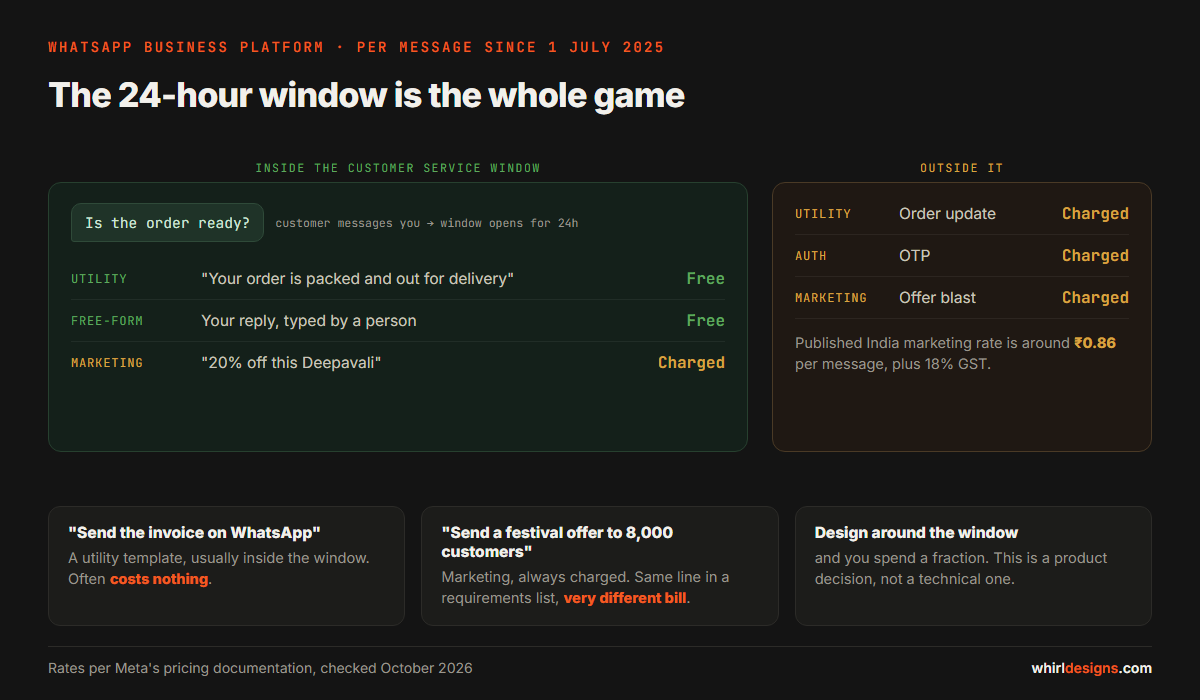
Since 1 July 2025, the WhatsApp Business Platform charges per message delivered, not per 24-hour conversation. Template messages fall into categories — marketing, utility and authentication — and the category sets the price.
Two facts worth knowing, from Meta's own pricing documentation:
- Utility templates delivered inside an open customer service window are free. So are ordinary non-template replies in that window. The window opens when the customer messages you and lasts 24 hours.
- Marketing templates are always charged. In India the published marketing rate is around ₹0.86 per message, plus 18% GST. At 10,000 messages a month that is a real line item; at 200 order updates a day sent as utility messages inside the window, it may be nothing.
So "send the invoice on WhatsApp" is cheap and "send a festival offer to 8,000 customers" is not, even though they look identical in a requirements list. Design the feature around the window and you will spend a fraction of what you otherwise would. We cover the setup side under WhatsApp Business API integration.
One more: the API is not the green WhatsApp Business app. It needs a phone number that is not on the app, a verified business, and an approval step for every template. Budget a week of calendar time for approvals you do not control.
6. Bank statements and the courier
Two smaller ones that show up in almost every operations system.
Bank reconciliation. Most Indian banks still hand you a CSV or an Excel download rather than a clean feed, and the column layout differs per bank and sometimes per download. Build around importing a file, not around a live connection, unless you are large enough for a corporate banking API.
Courier and tracking. Delhivery, DTDC, India Post, Shiprocket and the aggregators all publish APIs of varying quality. The useful question is not "can it book a shipment" but "what happens when the courier's API is down at 6pm on the day of a sale".
The pattern: every integration is a dependency
Each connection above is a promise made by somebody else. Portals go down. Rates change. A bank redesigns its statement export. Meta reprices a category. None of this is a reason to avoid integrating — it is a reason to insist that each one is built to fail softly.
Three design rules we hold to, and you can ask any vendor to hold to:
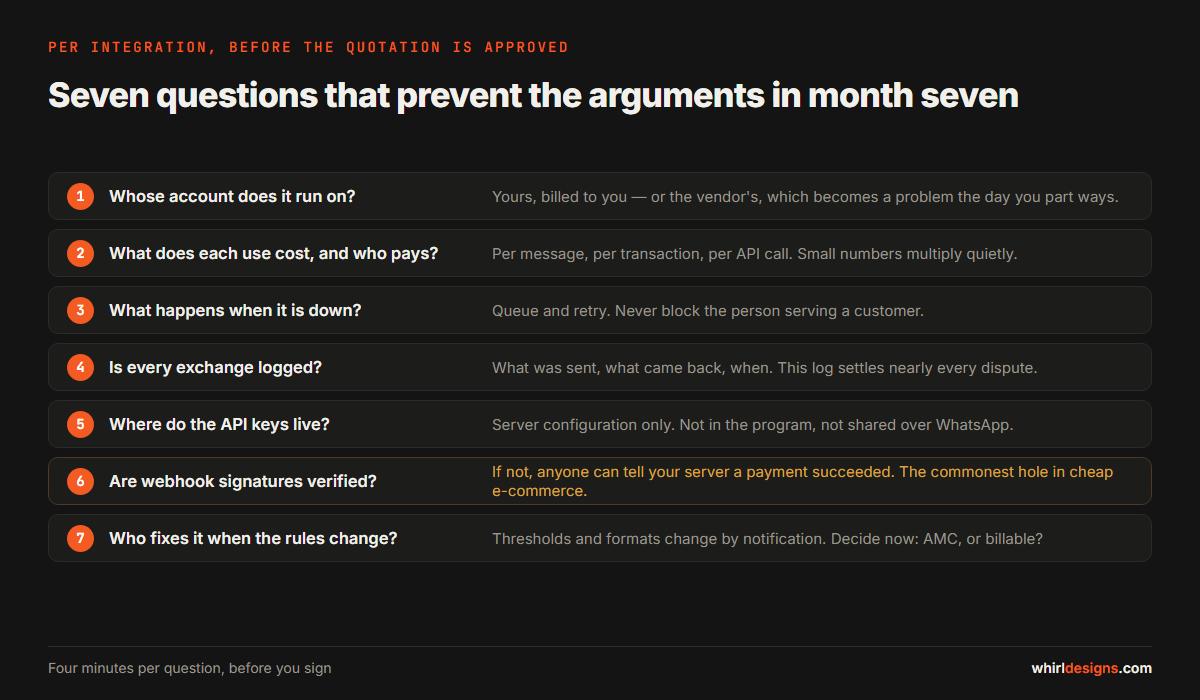
- Queue, do not block. If an external system is slow, the work gets saved and retried. The person at the counter is never stuck waiting for someone else's server.
- Log every exchange. What was sent, what came back, when. Nearly every dispute with a gateway or a portal is settled by this log, and it costs almost nothing to keep.
- Keep credentials out of the code. API keys in a configuration file that only the server reads, not pasted into the program and not shared over WhatsApp.
Before you sign
Take the integration list out of your brief and, for each line, get written answers to four things: whose account it runs on, what the per-use cost is and who pays it, what the software does when that system is unavailable, and who fixes it when the rules change. Four questions, five minutes each, and they prevent most of the arguments that happen in month seven.
And be honest about which integrations you need on day one. A system that bills correctly, prints a valid e-invoice and sends a WhatsApp utility message is a complete, useful product. Tally sync, courier booking and bank reconciliation can follow once the first version is running and you know what you actually use.
We build these connections as API development and integration work, and the GST and payment side under payments and GST e-invoicing integration. If you have a quotation in hand and want to know whether the integration lines are realistic, send it to us — we will read it and tell you what is missing.
Compliance figures in this article were checked in October 2026 against the sources linked above. GST thresholds and messaging rates change by notification; confirm current figures with your CA or the relevant portal before budgeting.