
There is an offer that goes around, and it is very hard to say no to. Someone opens a spreadsheet. You do thirty services. There are forty towns within driving distance. Thirty times forty is twelve hundred pages, each one aimed at a phrase somebody might actually type into Google. Twelve hundred chances to be found, instead of one.
It costs almost nothing to build, because the pages write themselves from a template. And the arithmetic seems unarguable. More pages, more keywords, more customers.
We know exactly how convincing it is, because we did it to our own website.
What happened when we audited ourselves
Before recommending a content audit to a client, we ran one on whirldesigns.com. Not a tool's score out of a hundred — an actual measurement of how much of each page was original writing.
The method is simple enough to explain in a sentence. Cut every page into overlapping six-word phrases. Count how many pages each phrase appears on. Any phrase that turns up on nearly every page is your header, your footer, your navigation, or template prose that happens to sit inside the article. Whatever is left over is the only part of that page genuinely about its own subject.
We ran it across all 255 pages of our site.
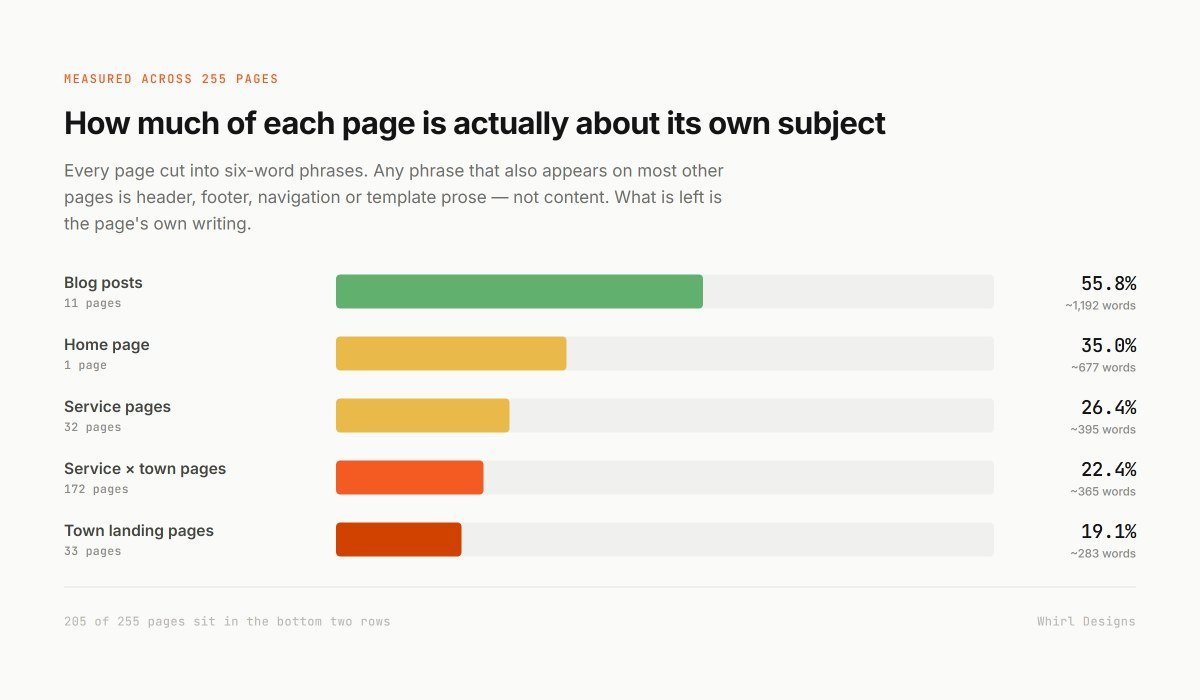
Our blog posts came out at 55.8% original — roughly 1,200 words of genuine writing in a 2,100-word article. That is what a page written by a person looks like.
The generated location pages came out at 19.1% and 22.4%. A page of about 1,600 words containing roughly 300 words that were actually about that town. And there were 205 of them, out of 255. Eighty per cent of our website was the same page wearing different names.
The part that surprises people
The instinctive reaction is: fine, so those pages do not rank. No harm done — they are still there if someone finds them.
That is not how it works, and this is the single most important thing in this article.
Google does not only judge pages. It forms a view of sites. In March 2024 it added a spam policy called scaled content abuse, aimed precisely at pages produced in bulk that exist to catch search traffic rather than to help the person reading. Around the same time, the helpful content system stopped being a separate filter and became part of core ranking.
The practical consequence: a large mass of thin, near-identical pages does not sit quietly in a corner. It becomes what your site mostly is, statistically. And it drags down the pages you actually care about — your home page, your service pages, and the handful of articles you sat down and wrote properly.
Our eleven blog posts were genuinely good. They were being held under water by 205 pages nobody would ever want to read.
This did used to work
It is worth saying plainly, because the people selling it are not lying about the past. Ten years ago you could rank a page by putting the right words on it enough times, and a page per town was a reasonable way to do that. Plenty of businesses were built on it.
What changed is that search engines stopped matching strings and started assessing whether a page was worth showing a human being. A template with a town name substituted in reads, to a modern ranking system, exactly like what it is. The tactic did not become risky recently. It became ineffective gradually, and then the penalties arrived on top.
"But my competitor does this and ranks"
Sometimes true, and worth being honest about. Two explanations usually cover it.
The first is that they rank despite the pages, not because of them. An established business with a decade of reviews, local links and a well-known name can carry a lot of dead weight and still show up. Copying the dead weight without the decade of reputation gets you the cost and none of the benefit.
The second is timing. Sites carrying large volumes of generated content have been losing visibility in wave after wave of updates since 2024. Ranking today on a tactic like this is not evidence that it is safe. It is evidence that your competitor has not been caught up with yet.
It also eats the crawl
There is a second cost, and it is easier to see than the first.
Google gives every site a rough budget of attention. Not unlimited, and for a small business site, not large. We pulled a month of crawler activity from our own logs to see where ours was going.
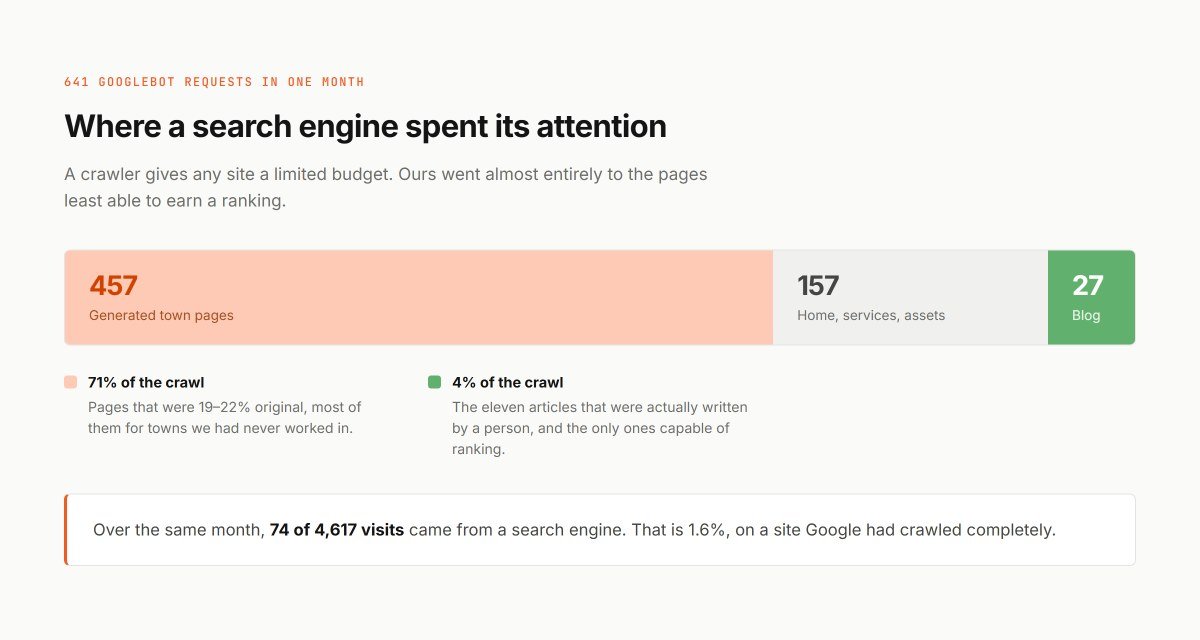
Of 641 Googlebot requests in a month, 457 went to the generated pages. Twenty-seven went to the blog. Seventy-one per cent of the attention we were given went to the weakest eighty per cent of the site, and four per cent went to the only part capable of ranking for anything.
Meanwhile 74 of 4,617 visits that month came from a search engine. That is 1.6%, on a site Google had crawled completely — every single page in the sitemap, without exception. This was never a technical problem. Google could see everything. It simply did not think much of what it saw.
The test that settles it
If you have location pages and you want to know which kind you have, there is a test that takes ten seconds and does not need any tools.
Open one. Swap the town name for a different town. Could you publish it as-is?
If the answer is yes, you do not have forty pages. You have one page and thirty-nine copies, and a search engine is extremely good at working that out.
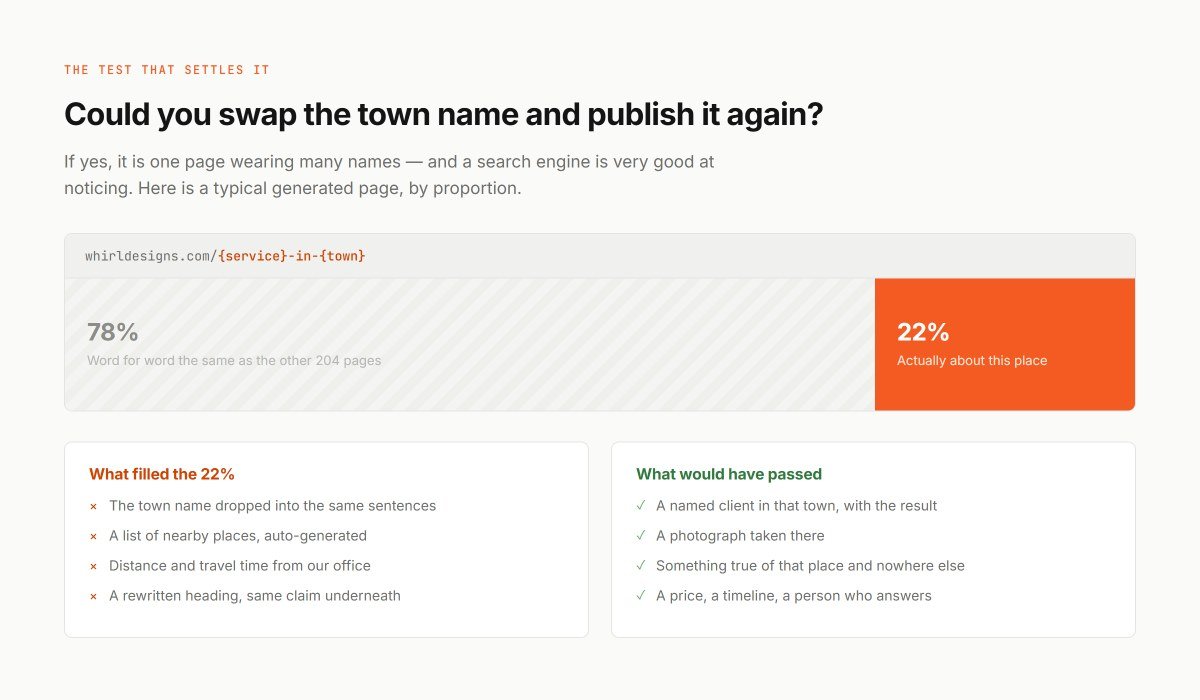
When we looked at what filled the 22% on our pages, it was thin stuff. The town name dropped into otherwise identical sentences. An auto-generated list of nearby villages. Driving distance from our office. A heading rewritten to sound different while making exactly the same claim.
None of that is knowledge about a place. It is the appearance of knowledge, assembled by a script.
Where to look for the evidence
If you want confirmation rather than a hunch, it is sitting in Google Search Console, which is free and takes a few minutes to verify.
Open Indexing → Pages. You are looking at the reasons listed under pages that are not indexed. Two of them matter here:
- Crawled — currently not indexed. Google fetched the page, read it, and decided against including it. On a location matrix this is the tell.
- Discovered — currently not indexed. Google knows the page exists and has not thought it worth fetching yet.
If most of your pages sit in those two buckets, no amount of further page-building will help. You are not being missed. You are being declined. While you are in there, check Manual actions too — usually empty, but you want to know if it is not.
What a real location page has in it
The good news is that location pages are not the problem. Empty location pages are the problem. A page about your work in a particular town can rank extremely well, and it is not hard to tell the difference.
A real one has things in it that could not exist for any other town:
- A named client from that town, what you built, and what changed for them afterwards. One real example is worth more than a thousand words of description.
- A photograph you took there. Not a stock image of a laptop.
- Something specific to the trade in that place. A fishing town, a temple town and a college town have genuinely different needs, and if you have worked in one you know what they are.
- A price, a timeline, and a person who answers the phone. The things a customer actually wants and most pages will not say.
Notice that all four are hard to fake and impossible to generate. That is exactly why they work.
Ten good pages beat two hundred empty ones
Here is the trade nobody making the spreadsheet pitch will tell you. Ten pages about places where you have genuinely worked will outperform two hundred generated ones, and it is not close.
The ten are pages a person would send to a friend. The two hundred are a liability that suppresses everything else on the domain.
So the honest advice is subtraction. Keep the towns where you have real customers and real stories. For the rest, either write them properly when you win work there, or do not have a page at all. Being absent from a search result is a neutral outcome. Being present with an obviously empty page is worse than both — it costs you the ranking and the credibility of everything else you publish.
If you remove pages, remove them properly
Deleting in a hurry causes its own problems, so three practical notes.
Do not redirect them all to your home page. It seems tidy and it is the most common mistake. When a redirect lands somewhere with nothing to do with the original page, Google treats it as a soft 404 and ignores it, and you have added a pile of confusing signals for nothing.
Prefer a clean 410 to a 404. Both mean the page is gone. 410 says gone deliberately, and Google acts on it a little faster. If a page has a genuine successor — a town page whose service page still exists — redirect it there instead. Only where it is honestly the same subject.
If you would rather keep a page than delete it, use noindex — and leave it crawlable. Blocking a page in robots.txt and adding noindex cancels the noindex, because a crawler that is not allowed to fetch the page never sees the instruction. It is a surprisingly common own goal.
What to do instead of building pages
If you have budget and energy for search, three things pay better than a page matrix:
Your Google Business Profile. For most local businesses, the map results matter more than the blue links, and the profile is free. Complete it properly, keep the hours right, add real photographs, ask satisfied customers for reviews and reply to them.
Genuinely useful articles. The thing our own audit made embarrassingly clear: the eleven articles were the only part of the site doing real work, and they were getting four per cent of the attention. Writing the twelfth is a better use of a day than generating another fifty pages.
Getting mentioned by other local sites. A link from a supplier, an association, a local news site or a client's own site is worth more than any number of pages you write about yourself. It is also slower and harder, which is precisely why it counts.
What we did about ours
We are not writing this as observers. We built the matrix, we measured it, and then we cut it: this site went from 255 pages to 60 in one afternoon. The generated pages now answer an honest 410, and nine towns remain — the ones with real customers — each being rewritten to earn its place.
We are publishing the numbers because an agency that will not audit its own site has no business auditing yours, and because the sales pitch that produced those 205 pages is being made to business owners across the coast this week. If it has been made to you, now you know what the spreadsheet leaves out.
Run the swap test on your own site this afternoon. If your pages pass, ignore everything above. If they do not, you have found something worth more than the pages ever were.