A customer puts a pair of old bangles on your counter and points at a necklace. The necklace comes to ₹1,00,000 before tax. The bangles are tested, weighed and valued at ₹40,000. Your billing staff now have one question: is GST charged on ₹1,00,000, or on the ₹60,000 the customer still has to pay?
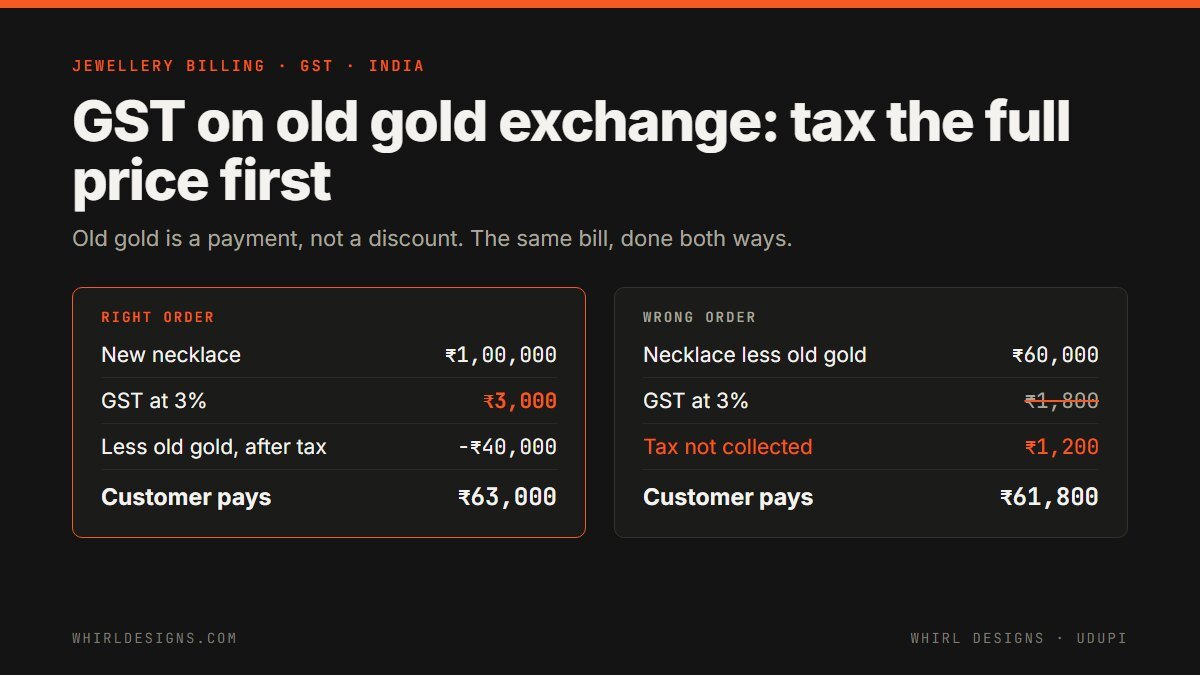
On ₹1,00,000. GST is charged on the full price of the new jewellery. The old gold is a way of paying, like cash or UPI, so it comes off after the tax is added. At 3%, the GST is ₹3,000 and the customer pays ₹63,000. Take the old gold off first and the GST drops to ₹1,800. The shop then collects ₹1,200 less tax than it owes on that one bill, and the shop, not the customer, has to make it up.
We build and maintain billing software for jewellers. The mistakes on this page are ones we have seen in jewellery billing software, and our own code is tested against every one of them.
The short answer
Tax the full sale first. Then take the old gold off the total, the same way you would take off cash.
| Step | Right order | Wrong order |
|---|---|---|
| Price of the new necklace | ₹1,00,000 | ₹1,00,000 |
| Old gold taken off before tax | No | ₹40,000, leaving ₹60,000 |
| GST at 3% | ₹3,000 | ₹1,800 |
| Total with GST | ₹1,03,000 | ₹61,800 |
| Less old gold | ₹40,000 | Already taken |
| Customer pays | ₹63,000 | ₹61,800 |
Gold jewellery is taxed at 3%: 1.5% CGST plus 1.5% SGST on a sale within the state, or 3% IGST on a sale to another state. The rate stayed at 3% when GST rates were reset on 22 September 2025. Jewellery (heading 7113) sits in Schedule IV of the new rate notifications (Notification 9/2025-Integrated Tax (Rate), on the CBIC site).
What the rules actually say
The clearest statement is in the GST FAQ for the jewellery trade, published by the All India Gem and Jewellery Domestic Council (GJC). Query 5 asks about old jewellery worth ₹10,000 plus ₹5,000 in cash, given for new jewellery priced at ₹15,000. The answer:
“GST is to be paid on the ‘open market value’ (i.e. retail price) of the new item of jewellery, i.e. Rs. 15,000.”
The same answer covers the case where the retail price is not known: GST is then paid on the cash plus the value of the old gold, ₹5,000 plus ₹10,000. Either way, the tax is on ₹15,000, not ₹5,000.
The FAQ dates from 2017, but the law behind it still stands. Section 15 of the CGST Act taxes the price paid when the price is the only thing the customer gives you. In an exchange it is not: part of the payment is gold. For that case, Rule 27 of the CGST Rules says the value is the open market value of what you sold. The rule's own example is a new phone sold for ₹20,000 plus an old phone. If the new phone costs ₹24,000 without the exchange, the value is ₹24,000. Put a necklace in place of the phone and you have the jeweller's case.
Some websites and billing apps say GST is due only on the net amount, usually because they treat old gold as a discount. The ones we read cite no rule for it.
This is our reading of public guidance, not legal advice. Confirm the treatment for your shop with your CA, and show them the links above.
Discount or payment? The one question that decides the tax
A discount cuts your price. When it is shown on the invoice, it lowers the taxable value (section 15(3) of the CGST Act), so it comes off before GST. A payment, which billing software often calls a tender, settles the bill, so it comes off after GST.
| What comes off the bill | Discount or payment? | When it comes off | Lowers the GST? |
|---|---|---|---|
| Bill discount | Discount | Before GST | Yes |
| Old gold exchange | Payment | After GST | No |
| Savings scheme credit | Payment | After GST | No |
| Customer wallet balance | Payment | After GST | No |
| Advance paid on an earlier day | Payment | After GST | No |
| Cash, UPI, card | Payment | After GST | No |
In the jewellery system we maintain, staff at a busy counter typed an advance the customer had paid days earlier into the Bill Discount box. There was nowhere else to put it. But it would have cut the GST on the whole sale.
An advance is a payment like any other. For a regular GST-registered shop, tax on goods is due when the invoice is issued, not when the advance arrives (Notification 66/2017-Central Tax). So the full sale is taxed on the bill, and the advance comes off after. We added a separate Advance field that records when and how it was paid, and takes it off after tax.
How to value the old gold
There are two common methods:
- The refinery method: work out the pure gold in the piece (weight × tested purity), take off the melting loss, and multiply by the 24K rate.
- The carat-rate method: take the melting deduction off the weight, then multiply by today's rate for the piece's carat.
The jeweller we built a system for chose the carat-rate method. With one day's 22K rate:
- Gross weight: 4.000 g, 22K
- Melting deduction at 2%: 0.080 g
- Net weight: 3.920 g
- 22K rate that day: ₹14,290 a gram
- Value: 3.920 × ₹14,290 = ₹56,016.80
The refinery method, which the system used before, gave ₹55,870.98 for the same piece. Close, but not the same. So pick one method, use it every time, and print it on the voucher. A customer who checks the sum at home should get your number.
Two mistakes to avoid:
- Counting purity twice. The 22K rate already prices 22K gold. Multiply by a tested purity as well, such as the 91.6% of a 22K916 hallmark, and you cut the value a second time: ₹51,311.39 instead of ₹56,016.80, about ₹4,700 short. Use the purity test to decide the carat, then apply that carat's rate and nothing else. We removed the separate “tested purity” box for this reason.
- One setting doing two jobs. Wastage charged on new jewellery and the melting deduction on old gold are different numbers. In one system a single setting did both, so setting the exchange deduction to zero would also have zeroed the wastage on every item sold. We split them.
When the old gold is worth more than the new piece
A customer trades a heavy old chain worth ₹50,000 for earrings that come to ₹30,000 with GST. The shop owes the customer ₹20,000. The bill should show the earrings, the GST on their full price, the old gold, and Payable to customer: ₹20,000, not a minus sign that everyone misreads. The cash book should record ₹20,000 going out, so the till balances at night.
We found two faults in billing code that broke this case before any such bill went through:
- A hidden cap. The code limited the old-gold credit to the value of the bill. It would have credited ₹30,000 and stopped, and the other ₹20,000 of the customer's gold would have vanished, with no refund and no record. The same cap sat in the counter screen, so staff saw the wrong figure too.
- A check that misread a minus. A safety check read a total below zero as “paid more than the bill” and refused to save. Staff reported it as “the bill is not generating”.
Both are fixed, and check 6 below tests for them. For larger payouts, ask your CA whether the money should go by bank transfer or UPI rather than cash.
Making charges: 3% or 5%?
For a ready-made ornament sold over the counter, it is 3% on the whole price, making charges included. The trade FAQ (Queries 4 and 96) says making should not be billed as a separate taxed line, though you may show it as a break-up of the price.
The 5% figure comes from job work: work done on goods that belong to another registered person (CGST Act, section 2(68)), such as a karigar making ornaments from a registered jeweller's gold. The FAQ also suggests splitting gold (3%) and labour (5%) for a piece made to the customer's own design. That case is less clear-cut, so ask your CA before billing it that way.
What a correct bill looks like
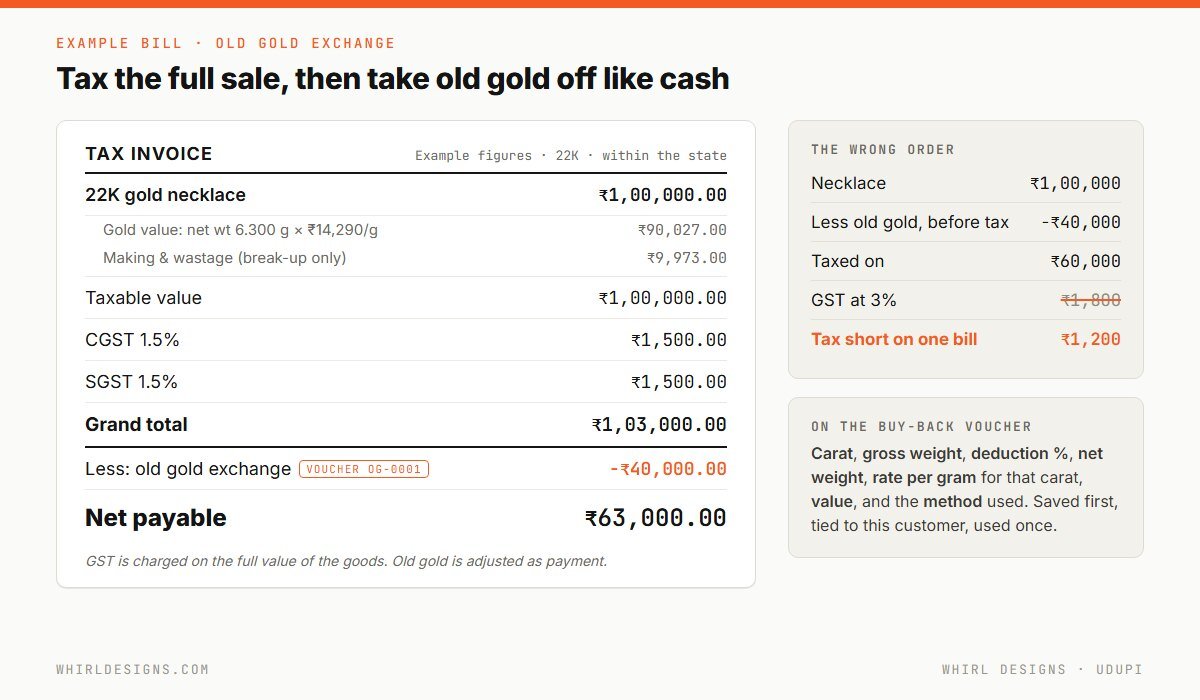
- The old gold sits below the grand total, as “Less: old gold exchange” with the voucher number. It is a payment line, not an item line.
- A footnote says so, for example: “GST is charged on the full value of the goods. Old gold is adjusted as payment.” A customer or auditor sees the order of steps without asking.
- The weighing is on the voucher: carat, gross weight, deduction %, net weight, rate per gram, value and method. A WhatsApp copy of the bill should carry the same weighing, because that is what customers check afterwards.
If you also sell to registered businesses, e-invoicing may apply to those bills. We cover that separately in GST e-invoicing, and what it does to your billing software.
Six checks for your billing software
You need one dummy customer and the numbers on this page.
1. Test with a dummy bill, never a real one
Saving a bill uses up an invoice number. GST invoices need a consecutive serial number, unique for the financial year (CGST Rules, rule 46(b)). A deleted test bill leaves a gap, and gaps are what auditors ask about. Use a test company or a calculator screen. If a wrong bill does get saved, cancel it (never delete it) so it stays in the series.
Enter a ₹1,00,000 piece, ₹40,000 of old gold and 3% GST. GST must read ₹3,000 and the customer must pay ₹63,000. If it shows ₹1,800, old gold is going off before tax.
2. The screen, the A4 invoice and the thermal slip agree
In the system we work on, the same sum sat in five places: the calculator, the counter screen, the A4 invoice, the thermal receipt and the saved bill view. Fix one and miss another, and the counter shows one figure while the stored bill says another. Print all three for one test bill and compare every line.
3. The old-gold credit comes from a saved voucher
The credit should come from a saved buy-back voucher that belongs to this customer and has not been used. The software should take the value from the voucher, not from a figure typed on screen. Otherwise one voucher can be spent twice, or land on someone else's bill.
4. Cancelling a bill frees the voucher
When a bill is cancelled, its old-gold voucher must become free again so the corrected bill can use it. Scheme credit and wallet money must go back to the customer too. A wrong voucher should be voided with a reason, not deleted, so every gram stays accounted for.
5. An advance has its own box
There should be a separate place for money paid earlier, with the date it was paid. If the only place is the discount box, staff will use it.
6. A bill that goes below zero still saves
Try ₹50,000 of old gold against a ₹30,000 bill. It should save, show “Payable to customer: ₹20,000” and record ₹20,000 going out of the cash book. If it refuses, or credits only ₹30,000, the customer is losing gold or your staff are patching it by hand.
Do you need new software for this?
Possibly not. If your current software passes all six checks, keep it. If it fails one, the fix is often in the billing step alone. Either way, keep Tally, or whatever your CA uses, for the books.
Whether a jewellery shop needs a full ERP is a bigger question. We covered it in why a small jeweller needs an ERP, not just accounting software, including when the honest answer is “not yet”.
Common questions
Is GST on old gold exchange charged on the full price or the net amount?
On the full price of the new jewellery. The jewellery trade's GST FAQ and CGST Rule 27 both value an exchange at the open market value of the new item. The old gold then comes off the tax-inclusive total as payment. Confirm the treatment for your shop with your CA.
Is old gold exchange a discount under GST?
No. A discount is a cut in the price you charge, and when it is shown on the invoice it lowers the taxable value. Old gold is something the customer hands over as part payment. It does not change the price of the new piece, so it does not reduce the GST on it.
Do I pay GST when I buy old gold from a customer?
Not when an ordinary retail customer sells you their own old jewellery. In July 2017 the government clarified that such a sale by an individual does not attract reverse charge. The trade FAQ agrees. Buying from a business is different, so ask your CA.
Should the old gold appear on the same bill as the new jewellery?
Yes, but below the grand total, not as an item line. The invoice shows the new piece, its taxable value and GST, then “Less: old gold exchange” with the voucher number, then the net payable. The full weighing goes on a separate buy-back voucher the customer keeps.
If your bill fails a check
If you are not sure your billing software takes old gold off after tax, run the six checks with a dummy bill. If it fails one, we can fix the bill without replacing the books you keep in Tally.
We are a small web and software studio in Udupi. These rules were built and tested in the jewellery billing and ERP we built for a Karkala gold house. Read about our POS and billing software and ERP development work, or tell us what your bill does today.