
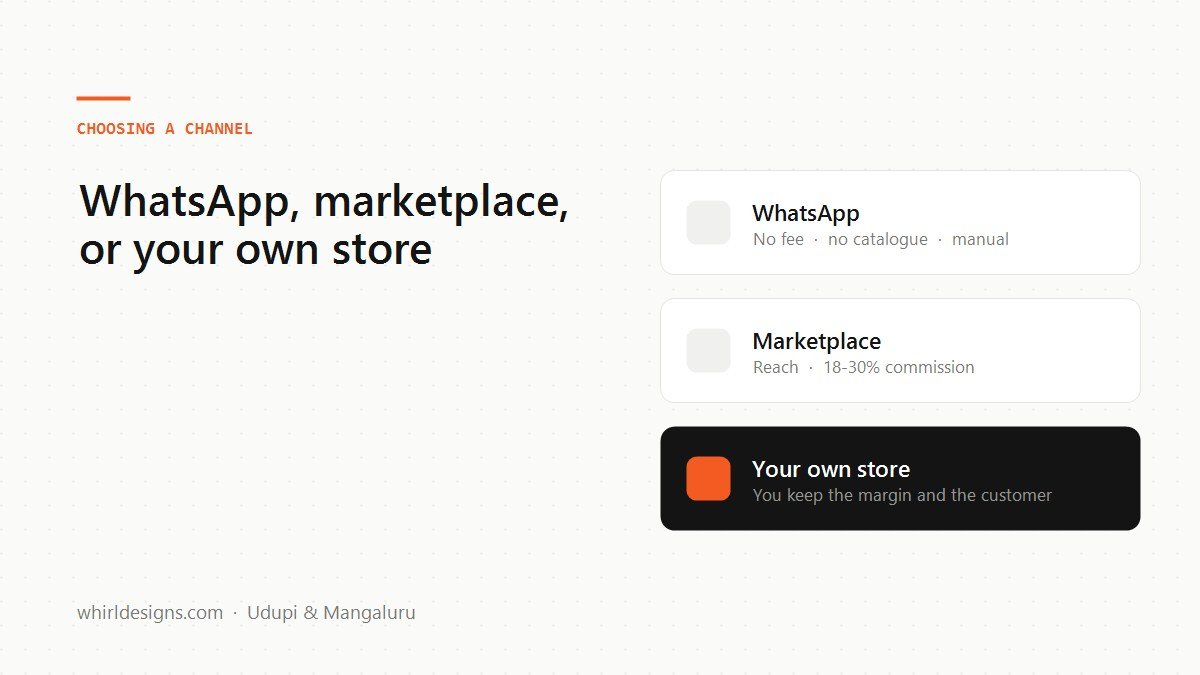
Nearly every small brand we meet in Udupi, Kundapura or Mangaluru is selling the same way: a WhatsApp catalogue, a UPI QR code, and a lot of manual typing. It works. Then somebody suggests Amazon or Flipkart, sales go up, and six months later the owner cannot work out why the bank balance has not moved.
All three channels are legitimate. They are just good at different things, and the costs are not comparable in the way they first appear.
WhatsApp: free, immediate, and it does not scale
What it is good at. Zero setup cost. Customers are already there. You can negotiate, upsell and answer questions in the same thread. For a business doing ten to thirty orders a week with repeat customers who know you, it is genuinely hard to beat.
Where it breaks. Every order costs you a conversation. You are the search function, the catalogue, the price list and the order tracker. At thirty orders a week that is manageable. At a hundred it is a full-time job that produces no record you can analyse — you cannot easily answer "what sold best last month" from a chat history.
It also has a quiet ceiling: nobody discovers you on WhatsApp. Every customer has to arrive from somewhere else first.
Marketplaces: reach you cannot build yourself, at a price
What they are good at. Amazon and Flipkart have the one thing you cannot manufacture — buyers already searching with their cards out. For a genuinely new product with no audience, that is worth a lot. Logistics and returns are handled. Trust is borrowed from the platform.
What it costs. This is where owners get caught, because the commission is not the whole number. Depending on category you are typically looking at a referral fee, a closing fee, shipping or fulfilment charges, and then advertising if you want to be visible at all — because the top of every marketplace search result is now paid. Add returns, which you often absorb.
The number that matters is not the commission percentage. It is what actually lands in your account per unit after everything. Work that out on your three best-selling items before you commit — for a lot of food and handicraft businesses in this region it turns a workable margin into a thin one.
The strategic cost. You do not get the customer. You get an order. No email, no phone number, no ability to tell them about next season's stock. You are renting an audience, and the rent rises.
Your own store: slower to start, yours to keep
What it is good at. You keep the margin, the customer relationship and the data. You can run your own offers, bundle products, collect emails and phone numbers, and sell to the same customer again at no acquisition cost. For a repeat-purchase product — coffee, spices, cashew, snacks, anything consumable — that second and third sale is the entire business, and it is exactly the sale a marketplace makes hardest.
What it costs. Real money up front and real attention afterwards. Somebody has to bring the traffic. A store nobody visits sells nothing, and that is the failure mode: a beautiful site, no plan for how anyone finds it.
So which one?
An honest rule of thumb:
- Starting out, under about thirty orders a week, mostly local? Stay on WhatsApp. Spend the money on photography and your Google listing instead. A store would be an expensive way to serve people who already know your number.
- A new product that nobody is searching for by name? A marketplace is a reasonable way to find your first thousand customers. Treat it as paid discovery, not as your business.
- Repeat purchases, or a brand people ask for by name? Build the store. Every repeat order through a marketplace is margin you are giving away for a customer you already had.
The combination most brands end up at
The businesses that do well rarely pick one. The pattern that keeps working:
- Marketplace for discovery — accept the commission on first-time buyers as an acquisition cost.
- A card in every parcel pointing to your own store, with a reason to use it: a better price, a bundle, something not sold on the marketplace.
- Your own store for repeats, where the margin is whole.
- WhatsApp for the relationship — order updates, restock alerts, the human bit. Not as the shop.
The store does not have to be elaborate to do that job. Clear product pages, honest photographs, sane shipping rules, a checkout that works on a mid-range Android phone on mobile data, and UPI as a first-class payment option rather than an afterthought. Most of the expensive parts of e-commerce are things a small brand does not need in year one.
Before you build anything
Work out your real per-unit margin on each channel — after commission, shipping, returns and advertising. Most people have never written those three numbers side by side, and it usually settles the argument on its own.
Common questions
Should a small business sell on WhatsApp or build an online store?
Under roughly thirty orders a week with mostly local repeat customers, WhatsApp is hard to beat and costs nothing. Build your own store when purchases repeat, because every repeat order through WhatsApp or a marketplace costs you either manual work or commission.
How much commission do marketplaces charge in India?
It varies by category, and the headline referral fee is not the whole cost. Add closing fees, shipping or fulfilment charges, advertising to be visible at all, and absorbed returns. Work out what actually reaches your bank per unit before committing.
Can I sell on a marketplace and my own store at the same time?
Yes, and most successful small brands do. Use the marketplace to find first-time buyers, put a card in every parcel pointing to your own store with a reason to use it, and keep the repeat orders where the margin is whole.