In February 2025, Andrej Karpathy — a founding member of OpenAI and former AI lead at Tesla — posted a short description of how he'd started building software: describe what you want, let an AI agent write it, run it, and fix problems by describing them again rather than reading the code. He called it "vibe coding," and the name stuck hard enough to become Collins Dictionary's Word of the Year for 2025. By 2026 it's no longer a novelty — it's how a large share of new software actually gets started, for better and for worse.
This guide covers what vibe coding actually means, how it's different from traditional development, which tools people are using, and — the part most guides skip — when it's genuinely the right call versus when it quietly creates a mess you'll pay for later.
What is vibe coding?
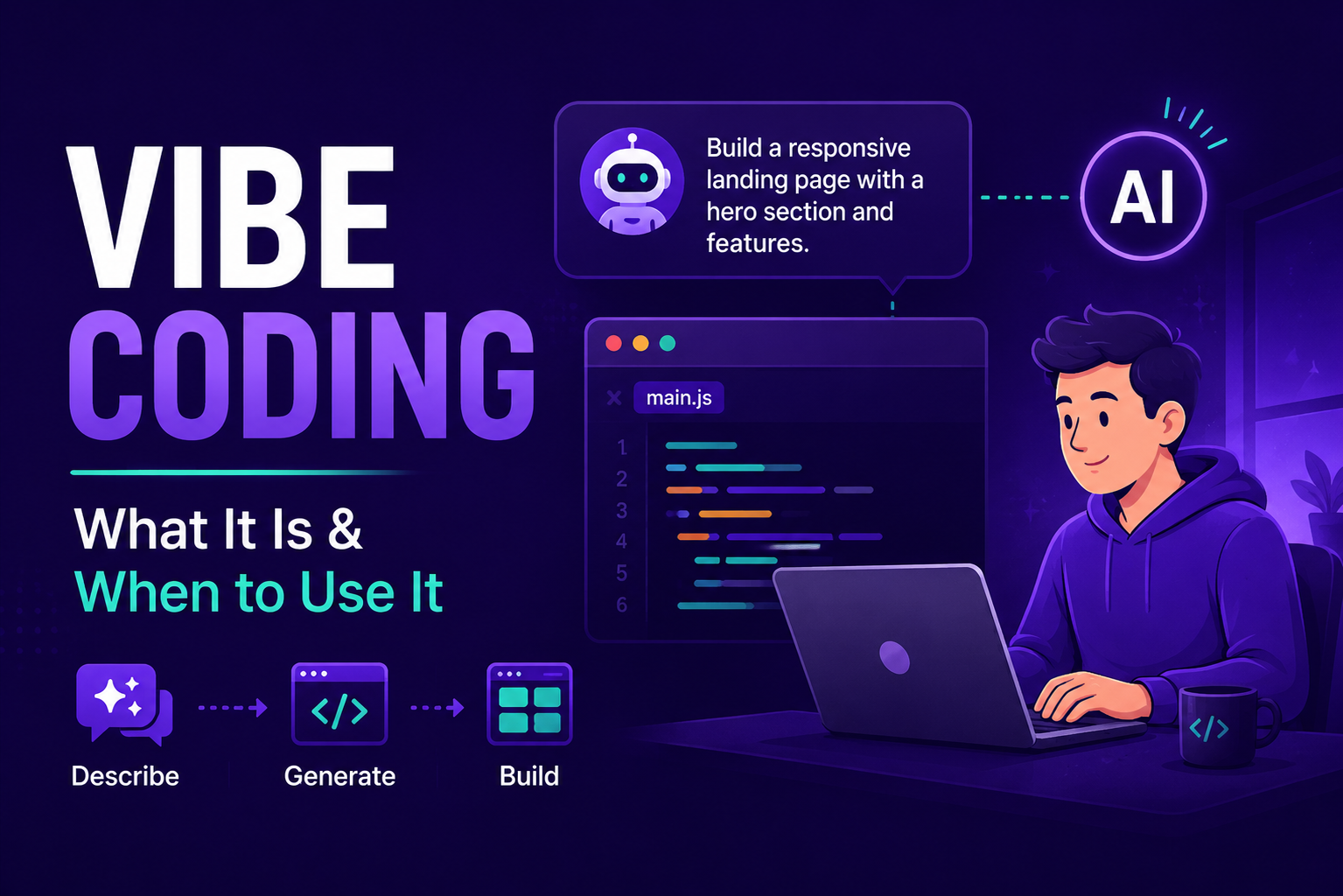
Vibe coding is building software by describing your intent in plain language and letting an AI agent generate, run and revise the code, rather than writing it line by line yourself. Instead of thinking in syntax and APIs, you think in outcomes — "add a login screen with email and password" — and the model handles implementation.
Cursor, Claude Code, etc.
The important detail in that loop is the last box. The people getting real value from vibe coding in 2026 aren't the ones who skip review — they're the ones treating themselves as the orchestrator, not a passenger.
Vibe coding vs traditional coding
Traditional development means you write, understand and own every line. Vibe coding shifts your job from writing implementation to directing it — which changes what skill actually matters day to day.
| Aspect | Traditional coding | Vibe coding |
|---|---|---|
| Primary skill | Writing correct syntax and logic | Describing intent clearly and reviewing output |
| Speed to prototype | Hours to days for a first working version | Minutes to hours for a first working version |
| Code ownership | Developer understands every line | Often accepted without full understanding |
| Review needs | Standard code review | Heavier review — AI code ships more security issues on average |
| Best suited for | Production systems, long-lived codebases | Prototypes, MVPs, internal tools, throwaway scripts |
| Barrier to entry | Requires programming training | Open to non-programmers who can describe a goal clearly |
Why it's everywhere in 2026
- The tools got genuinely good. Agentic coding tools like Cursor, Claude Code and GitHub Copilot can now edit multiple files, run commands, and hold onto project context across a long session — not just autocomplete a line.
- Prototyping got nearly free. Browser tools like Lovable and Bolt.new let anyone go from an idea to a deployed, working app in a single sitting, no local setup required.
- Non-programmers can now ship. Designers, founders and marketers are shipping real, working software by describing what they want instead of learning to code first.
- It compounds for experienced developers too. Senior engineers use it to skip boilerplate — auth flows, CRUD screens, database schemas — and spend their attention on architecture and judgment calls instead.
Popular vibe coding tools
Different tools are built for different jobs. A rough map of where each one fits:
A common pattern by mid-2026: prototype fast in a browser tool like Lovable or Bolt, validate the idea, then hand the codebase to Cursor or Claude Code for the hardening and production work.
Is vibe coding right for your project?
It depends what "right" needs to mean. Vibe coding is excellent for speed and exploration, and genuinely risky when treated as a finished production strategy.
Independent research through 2025 and 2026 has been consistent on the trade-off: AI-co-authored code ships with meaningfully more security issues than human-reviewed code at the same review depth, and the gap doesn't close just because the model is bigger or newer. That doesn't make vibe coding a bad idea — it makes unreviewed vibe coding a bad idea for anything that matters.
Good fits:
- Prototypes and proof-of-concepts you're using to validate an idea
- Internal tools and dashboards with a small, known audience
- MVPs you plan to harden before real users depend on them
- Scripts, automations, and one-off tooling
Where it needs real guardrails:
- Anything handling payments, personal data, or authentication
- Production systems other people depend on staying up
- Codebases that need to be maintained and understood a year from now
How we approach vibe-coded builds
We use AI-assisted development the way the most disciplined teams in 2026 do — as an accelerator inside a workflow that still has real engineering judgment at every stage, not as a replacement for it.
- Describe intent — we turn your goals into a clear spec, not just a chat prompt, so the "why" survives past the first draft.
- Generate — AI agents produce the first working version fast: UI, backend logic, schemas, boilerplate.
- Review & test — a human engineer actually reads the output, runs it, and checks it does what you meant, not just what you said.
- Harden & secure — static analysis and security review on the AI-generated sections specifically, since that's where issues concentrate.
- Ship — deployed with the same care as any other project, with documentation of what came from a prompt so future maintenance starts in the right place.
Frequently asked questions
Is vibe coding just for beginners?
No. It started that way, but experienced engineers now use it constantly to skip boilerplate and speed up prototyping — the difference is they review everything before it ships.
Can I vibe code a real, production app?
You can vibe code the first version of one. Getting it production-ready — proper auth, a real database, payments, deployment, security review — is still real engineering work, and it's usually where unsupervised vibe coding runs into trouble.
Is AI-generated code less secure?
On average, yes, based on independent 2025-2026 research — AI-co-authored code has shown notably higher rates of security issues than human-reviewed code, even as the tools have gotten better at producing code that simply runs. That's exactly why review and hardening stay non-negotiable steps, not optional ones.
Do you build using vibe coding?
We use AI-assisted tools throughout our process because they make us faster — but every project goes through human review, testing and security hardening before it ships. The speed is real; so is the accountability.
What's the difference between vibe coding and "agentic engineering"?
Vibe coding at its loosest means trusting AI output with minimal review. Agentic engineering — the term Karpathy himself has since pushed toward for professional work — means orchestrating AI agents deliberately, with specs, tests and review gates, and staying accountable for what ships.
Vibe coding is a great way to find out what you want to build. It's not, by itself, a way to guarantee the thing you built is safe to depend on.
If you've got an idea you want to prototype fast — or a vibe-coded MVP that's ready to become something real — that's exactly the kind of project we like taking on. We handle the full path from a rough idea to a secure, maintainable product: custom software development, web application development, and the review and hardening work that turns a fast prototype into something you can actually rely on. Start a project and we'll give you an honest read on the fastest safe path from where you are to a real, shippable product.