Type a question into Google today, and there's a good chance you'll never click a single blue link. An AI-generated answer sits right at the top, already telling you what you need to know — sourced, summarized, and served in seconds. Ask the same question in ChatGPT or Perplexity, and you get a direct answer with citations, no scrolling required.
This is the biggest shift in how people find information since Google itself launched — and most businesses haven't caught up.
If your content isn't structured for AI systems to read, understand, and quote, you're invisible in a growing share of searches. Ranking #1 the old-fashioned way doesn't help if the person never sees a results page at all. This is where Answer Engine Optimization (AEO) comes in.
What Is Answer Engine Optimization (AEO)?
Answer Engine Optimization is the practice of structuring your website and content so that AI answer engines — ChatGPT, Perplexity, Gemini, Google AI Overviews, and similar tools — can find, understand, trust, and directly cite your business when someone asks a relevant question.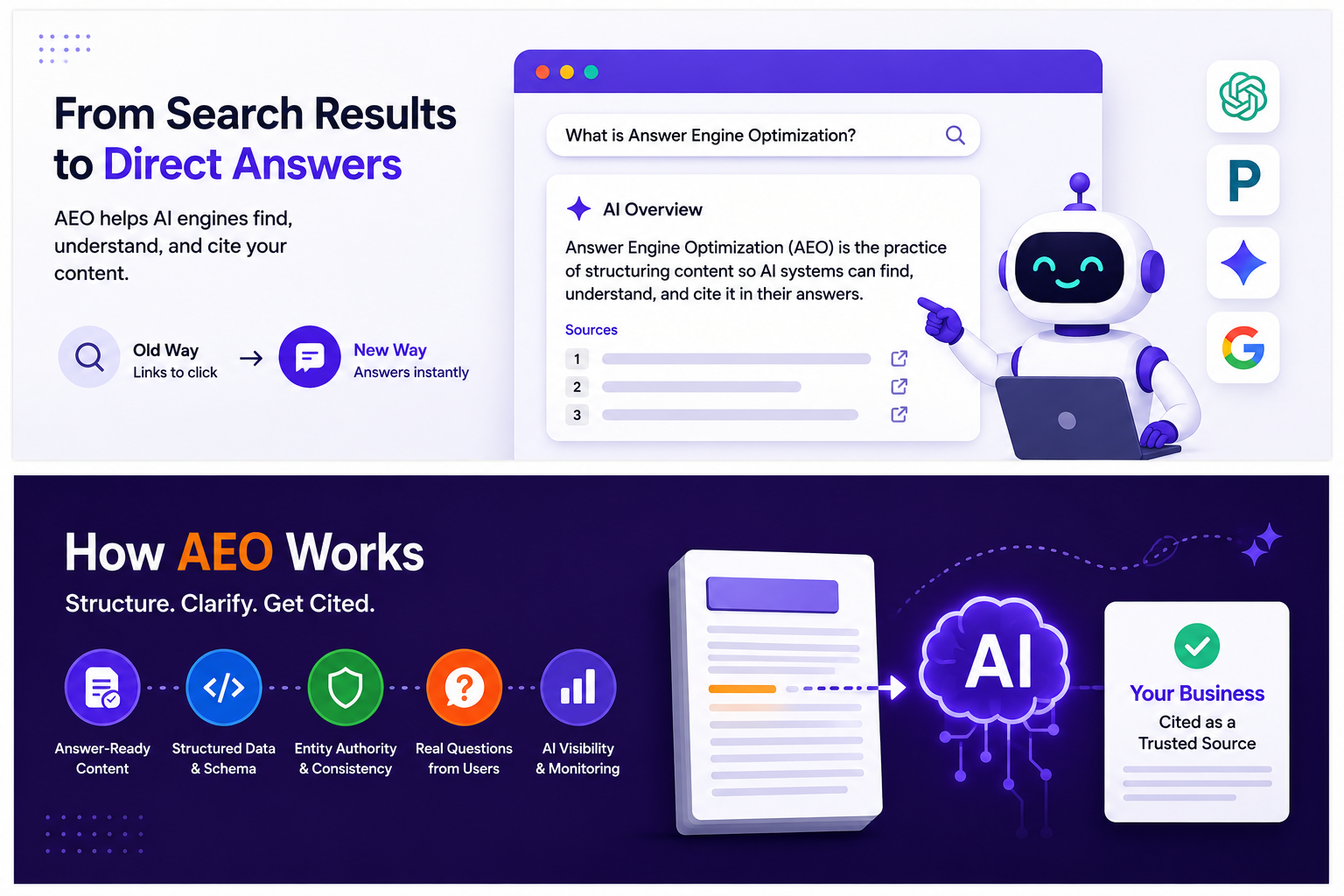
Instead of optimizing purely to rank in a list of links a person has to click through, AEO optimizes for a different outcome entirely: being the source an AI reads and quotes in the answer itself.
It sounds like a subtle distinction, but it changes almost everything about how content should be written and structured.
AEO vs. SEO: What's the Difference?
Traditional SEO and AEO aren't rivals — they're overlapping disciplines with different end goals.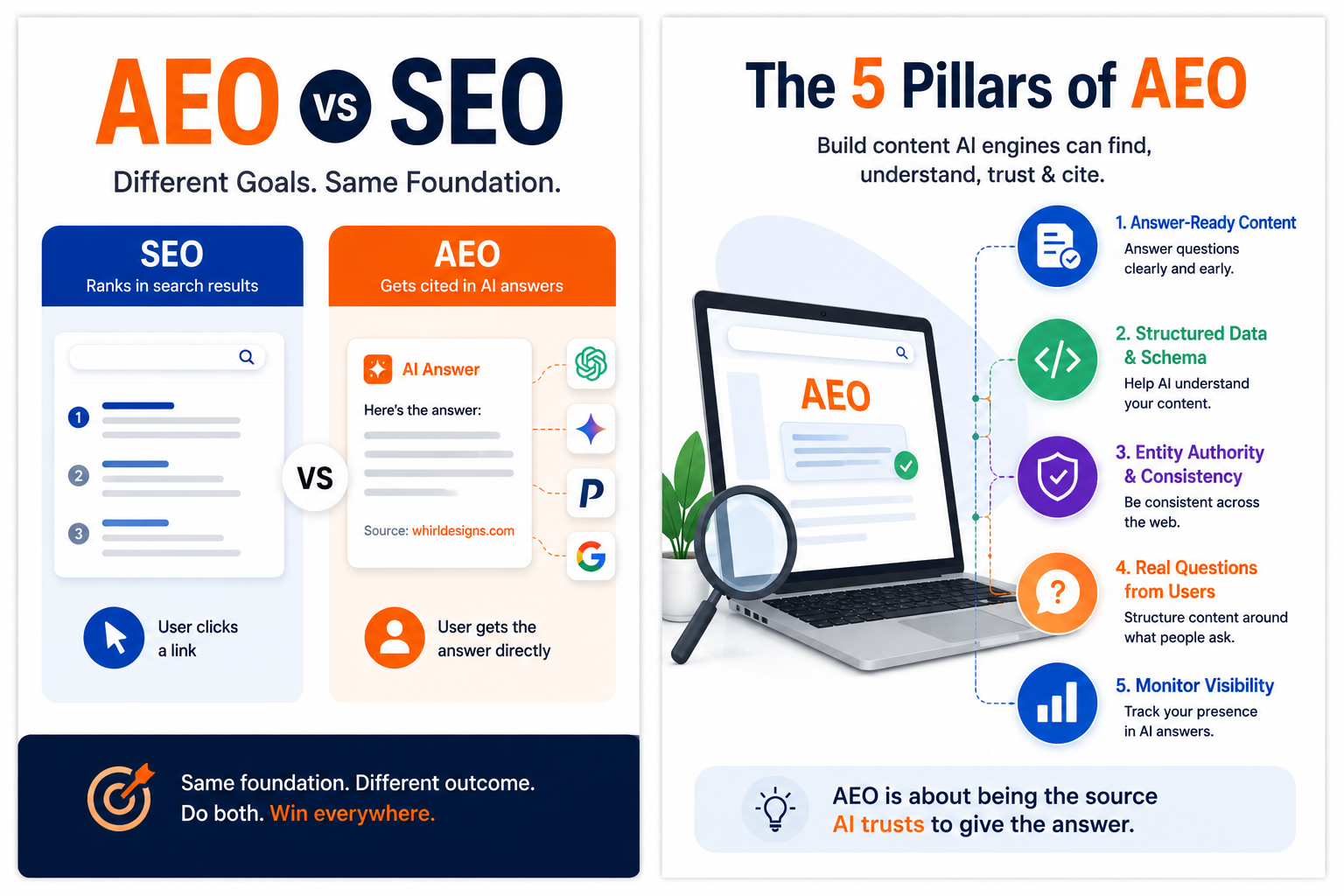
- SEO optimizes for ranking in a list of links that a human then clicks through.
- AEO optimizes for being the source an AI reads, synthesizes, and quotes directly — often without the person ever visiting your site.
The two share a lot of DNA. Fast pages, clean site structure, and quality content matter for both. But AEO adds a layer on top: your content also needs to be easy for a language model to lift a clear, accurate answer from — which means it needs to be structured very differently than a page written purely to rank on a SERP.
You don't choose one over the other. The businesses winning in 2026 are doing both together.
Why AEO Matters Right Now
A few things are converging at once:
- AI Overviews are now the default experience for a huge share of Google searches, especially informational ones.
- ChatGPT, Perplexity, and Gemini are becoming search engines in their own right, with hundreds of millions of people asking them questions they used to type into Google.
- Zero-click behavior is accelerating. People get their answer without visiting any website — which means if you're not the cited source, you get zero visibility, not just reduced visibility.
- Trust concentrates on fewer sources. AI systems tend to repeatedly cite the same well-structured, authoritative sources for a given topic — so early movers in a niche compound their advantage.
If you wait until this is "mainstream," you'll be optimizing for a landscape where your competitors are already the default citation.
The Core Pillars of AEO
Here's what actually moves the needle, in practical order of impact.
1. Write Answer-Ready Content
AI systems favor content that answers a question directly, clearly, and early — not content that buries the answer under three paragraphs of preamble.
For every important page or article, ask: if someone asked this exact question to an AI, could it lift a clean 2–3 sentence answer straight from this page? If not, restructure it.
Practical tactics:
- Open sections with a direct answer, then expand with detail and nuance afterward.
- Use clear, descriptive headings that mirror how people actually phrase questions ("How much does X cost?" rather than "Pricing Considerations").
- Keep key facts — numbers, dates, definitions — stated plainly, not implied or buried in narrative.
2. Implement Structured Data and Schema Markup
Structured data is how you hand machines a map instead of making them guess. Schema.org markup and JSON-LD tell search engines and AI crawlers exactly what your content is: an FAQ, a product, a service, a business location, a review.
Priority schema types for most businesses:
- Organization / LocalBusiness — who you are, where you operate, how to reach you.
- FAQPage — direct question-and-answer pairs, exactly the format AI engines love to lift.
- Article / BlogPosting — authorship, publish date, and topic clarity.
- Service — what you offer, structured cleanly.
Beyond classic schema, an emerging practice is publishing an llms.txt file — a plain-text summary of your site aimed specifically at AI crawlers, similar in spirit to robots.txt but for language models rather than search bots.
3. Build Entity Authority and Consistency
AI systems are increasingly trained to trust entities — consistent, verifiable facts about a real business — over generic web pages. If your business name, address, services, and key facts are stated differently across your website, directories, social profiles, and press mentions, you're sending confusing signals.
- Keep your NAP (name, address, phone) identical everywhere.
- Make sure your "About" page, Google Business Profile, and any directory listings agree on the same facts.
- Get cited accurately in other credible sources — press, partner sites, industry directories — since AI systems cross-reference multiple sources to build confidence in a claim.
4. Structure Content Around Real Questions
This is the single highest-leverage habit you can build. Every AI answer engine is, fundamentally, a question-answering machine. Content built around actual questions your customers ask outperforms content built around keywords.
- Maintain a genuine FAQ section on key pages, marked up with FAQPage schema.
- Write blog content that mirrors real customer questions, not just keyword phrases ("How much does a custom web app cost in 2026?" beats "web app development pricing").
- Update these regularly — stale answers get replaced by fresher, more current sources.
5. Monitor Your AI Visibility
You can't guarantee a specific citation from a system you don't control — and you shouldn't trust anyone who claims otherwise. What you can do is track whether you're showing up.
- Periodically ask ChatGPT, Perplexity, and Gemini the exact questions your customers would ask, and see whether — and how — you're mentioned.
- Watch for changes after you publish or restructure content, and refine based on what actually moves.
- Treat this as an ongoing practice, not a one-time audit. AI answer patterns shift as models update.
Common AEO Mistakes to Avoid
- Writing for keywords instead of questions. AI engines reward clarity and directness, not keyword density.
- Skipping schema markup entirely. This is one of the cheapest, highest-leverage technical wins available.
- Inconsistent business facts across the web. Confusing signals erode the trust AI systems need to cite you confidently.
- Treating AEO as a replacement for SEO. It's an addition, not a substitute — the fundamentals of fast, well-structured, quality websites still matter enormously.
- Expecting guaranteed results. Nobody controls what a third-party AI model chooses to cite. The honest goal is stacking every signal in your favor, not chasing guarantees.
Getting Started with AEO
If you're serious about showing up where your customers are actually asking questions now, start with an honest audit:
- Ask ChatGPT, Perplexity, and Google a handful of real questions about your industry and see who gets cited.
- Check whether your site has basic schema markup in place (Organization, FAQPage, Service).
- Pick your five most important pages and rewrite the openings to answer the core question directly, in plain language.
- Build out a genuine FAQ section with real customer questions, properly marked up.
- Make sure your business facts are consistent everywhere you're listed online.
None of this requires abandoning what you already know about good SEO — it means extending it for a world where a growing share of "search" happens entirely inside a conversation with an AI.
Need help implementing Answer Engine Optimization for your business? We help companies structure their content, schema, and site architecture so AI answer engines can find, trust, and cite them — alongside the technical SEO fundamentals that still matter. Get in touch to talk through where you stand today.